Solid Wood vs Veneer Furniture: The Core Difference
The solid wood vs veneer question comes down to what sits beneath the surface. Solid wood is timber cut from a single tree through its full thickness.
That distinction shapes how the piece ages, handles humidity, what it costs and whether it can be sanded back decades from now. Neither construction is automatically better, what matters is whether the maker used the right method for the piece.
This guide breaks down the difference between solid wood and veneer furniture across durability, cost, climate response and long-term care, so you can tell which construction you are looking at before you buy.
How to Identify Solid Wood Furniture in Person
The fastest test is to look at the edges and the underside, not the top. Solid wood shows continuous grain through the board's thickness, often with visible end grain.
In practice, check these five points:
Edges: On solid timber, grain and colour continue through the edge. On veneer, the edge is often capped with a separate strip.
Underside: Flip the piece. Manufacturers rarely veneer surfaces nobody sees. Bare particleboard or MDF underneath is a strong signal.
Weight: Solid timber is heavy for its size. Engineered cores are noticeably lighter to lift.
Grain continuity: On veneer, grain can repeat or mirror across panels, because slices come from the same flitch.
Sound: Tap the surface. Solid timber gives a dull, dense thud; a hollow core sounds thinner.
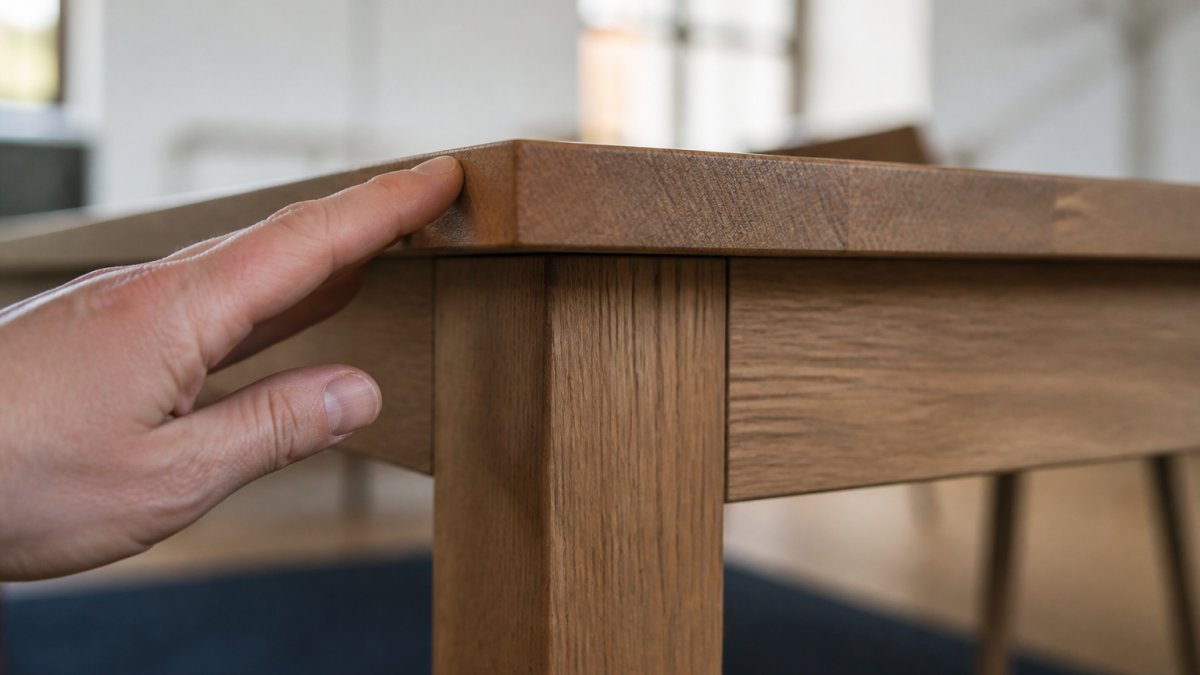
Close-up of a person's hand running along the underside edge of a timber table, revealing end grain and a visible join line where the top meets the leg
Durability, Repairability and Climate Sensitivity Compared
The durability gap between solid wood and veneer is real but narrower than most guides admit, and it depends almost entirely on two variables: veneer face thickness and core material.
Veneer's advantage is dimensional stability. A thin timber face bonded to an engineered core moves far less with seasonal humidity than a wide solid board, because the core is manufactured to a stable moisture content.
How Veneer Thickness Changes Everything
Veneer is not one product. It sits on a spectrum:
Paper-thin veneer (under 0.5 mm): Common on mass-market flat-pack furniture. You can see through it if you hold it to light. One aggressive sanding cuts through to the core. Repairs are almost impossible to hide.
Standard veneer (0.5-1 mm): The typical range for mid-market furniture. Light sanding is possible but risky. A deep scratch usually needs a filler and colour match rather than sanding out.
Thick veneer (1.5-2 mm+): Found on better furniture. Behaves much more like solid timber. Can be lightly sanded and refinished once or twice. Often called "thick-cut" or "sawn" veneer.
Substrate Quality: The Hidden Variable
A veneer is only as stable as its core. The three common cores behave very differently:
Particleboard: Cheap, dense, and swells permanently if moisture reaches the edges. Once swollen, it cannot be compressed back. Edges must be sealed perfectly.
MDF: Smoother and more uniform than particleboard, takes veneer well, but also swells irreversibly when wet. Heavier than particleboard.
Plywood: Made from crossed timber layers, so it moves in a similar way to solid timber but far less. The most dimensionally stable core, and the only one that tolerates minor moisture exposure without permanent swelling. Also the most expensive.
A thick veneer over a quality plywood core is a genuinely durable construction. A paper-thin veneer over particleboard is not, regardless of how good it looks in the showroom.
How Humidity and Dry Air Affect Each Material
Timber is hygroscopic: it absorbs and releases moisture until it reaches equilibrium with the surrounding air.
Engineered cores are manufactured at a stable moisture content and their cross-lamination resists movement, a veneered panel over plywood might move a fraction of a millimetre across the same seasonal swing.
Where solid timber wins is recovery. A dent, scratch, or water ring on a solid top can be sanded out and refinished.
Watch OutPlacing any timber piece directly against a heater, or in a room with no humidity control, is the fastest way to cause cracking and joint separation. On solid timber the damage can often be sanded out. On veneer, the surface layer is too thin to sand back, so the damage is frequently permanent.
A Realistic Lifespan Comparison
Assuming normal indoor use and reasonable humidity control:
Solid timber, well made: 50+ years, with refinishing every 10-15 years.
Thick veneer over plywood: 25-40 years, with careful surface care and no aggressive sanding.
Standard veneer over MDF: 15-25 years, provided edges stay sealed.
Paper-thin veneer over particleboard: 5-15 years, and often less if it sees any moisture.
The construction matters more than the label. A well-built veneer piece will outlast a cheap solid piece every time.
The Pros and Cons of Wood Veneer
Most guides treat veneer as a single category. That is the wrong frame. Veneer is a construction method, not a material grade, and its performance depends almost entirely on two things marketing rarely mentions: face veneer thickness and substrate quality.
Why Veneer Exists
Veneer is a deliberate engineering choice that solves three real problems:
Stability. A thin timber face bonded to a cross-laminated core moves far less with humidity than a wide solid board, so veneered cabinet doors stay flat while solid timber doors can cup.
Yield. A single high-quality log can be sliced into enough veneer leaves to cover dozens of panels, while solid timber uses the whole log for a single piece. That is the core reason veneer costs less.
Grain access. Rare and figured timbers, burl, crotch, quilted maple, are almost never available as wide solid boards, but as veneer they can be matched across a large panel.
The Pros, Properly Qualified
Dimensional stability: True, but only if the core is plywood or well-sealed MDF. A poorly sealed particleboard core will swell at the edges if moisture reaches it.
Lower cost: True, but the saving comes from the core, not the face. A thick veneer over plywood is not cheap to make.
Consistent appearance: Book-matched veneer creates symmetrical grain patterns that solid timber cannot achieve across a wide panel.
Design flexibility: Curved and complex shapes are far easier to produce in veneer, because the thin face bends to the substrate.
The Cons, Properly Qualified
Limited refinishing life: The biggest limitation. A 0.5 mm veneer cannot be sanded; a 2 mm veneer can be lightly sanded once or twice. The difference is enormous and invisible from the showroom floor.
Repair difficulty: Deep scratches and dents cannot be sanded out, they must be filled, colour-matched, and sometimes re-veneered in sections. Specialist work.
Edge vulnerability: Edges are where moisture gets in and damage starts. Quality pieces use solid timber edge banding; cheap pieces use thin melamine or PVC strips that peel.
Quality variance: Two veneered pieces at the same price can differ enormously in veneer thickness and core density. Without asking, you cannot tell.
The Substrate Question Nobody Asks
When you buy veneer furniture, you are buying two materials: the face and the core. The face gets the attention; the core determines how the piece ages.
Particleboard core: Cheapest option. Dense and flat when new, but swells permanently if moisture reaches the edges and cannot be repaired. Suitable for low-traffic, dry rooms only.
MDF core: Smoother and more uniform, takes veneer well, machines cleanly. Still swells irreversibly when wet. Heavier than particleboard. Common in mid-market furniture.
Plywood core: Cross-laminated timber layers that move like solid timber but far less, tolerating minor moisture without permanent damage. The most durable and most expensive core, common in better furniture and pieces for humid climates.
A common pattern among restorers is that veneered furniture over plywood can be repaired and refinished decades later, while the same damage on a particleboard core is usually terminal.
What to Ask Before You Buy
If a retailer cannot answer these three questions, the construction is probably not worth the price:
What is the veneer thickness in millimetres?
What is the core made of, particleboard, MDF, or plywood?
Are the edges solid timber or applied banding?
Pro TipVeneer thickness is the single best predictor of how a piece will age. Under 0.5 mm is disposable. Around 1 mm is standard. Over 1.5 mm behaves much more like solid timber and can be lightly refinished. Always ask for the number.
Cost, Craft and What You Are Actually Paying For
Solid wood costs more because you are buying full-thickness timber and the yield from each tree is lower. Veneer costs less because a single log can be sliced into many thin leaves over a manufactured core.
What you are actually paying for is substrate quality, joinery and finish. A veneered piece over a dense, well-sealed core with a thick face veneer will outlast a cheap solid piece assembled from short, poorly dried boards.
For a sense of how the two sit side by side in a real collection, the Colonnade Dining Table is handcrafted from solid old mango timbers, while the Wylde Veneer Buffet pairs a walnut oak veneer with an engineered core. Different jobs, different builds.
Colonnade Dining Table
Wylde Veneer Buffet
Pro TipAsk any retailer for the substrate and veneer thickness in writing before you buy. A maker confident in their construction will answer without hesitation. One who cannot is usually hiding a thin face over a low-density core.
Maintaining Timber Furniture: A Realistic Schedule
Maintenance differs by construction. The schedule below is what works in practice, not what looks good on a care card, the goal is stable humidity, gentle cleaning and early attention to damage.
Weekly: Dust with a dry, soft cloth. Skip silicone polishes; they build up and dull the finish.
Monthly: Wipe with a barely damp cloth and dry immediately. Check edges and joints for lifting.
Seasonally: Inspect for scratches, water rings and any lifting veneer. Address small issues before they spread.
Annually: Apply a suitable finish or wax if the surface looks dry. Solid timber can be sanded and refinished when wear is significant.
Ongoing: Keep rooms between roughly 40 and 60 percent humidity and out of direct sun.
For veneer, treat every scratch as urgent, because you cannot sand your way out of a deep one. For solid timber, you have more room to work with over the decades.
Key TakeawayHumidity control matters more than any polish. Keep timber furniture in stable, moderate conditions and both solid and veneer pieces will age far better than the same furniture in a dry, fluctuating room.
Conclusion: Choosing Between Solid Wood and Veneer
The difference between solid wood and veneer furniture is not good versus bad, it is purpose. Solid timber suits statement pieces you intend to keep and refinish for decades. Veneer suits large panels, consistent grain and pieces where stability and value matter most.
Explore designer furniture crafted from solid timber and quality veneer, with the craftsmanship and materials spelled out before you buy.
Frequently Asked Questions
What is the primary difference between solid wood and veneer furniture?
Solid wood is cut from a single piece of timber through its full thickness, so the grain runs all the way through and can be sanded back repeatedly. Veneer is a thin slice of real timber bonded to an engineered core such as MDF, particleboard or plywood. Both use genuine wood on the surface, but only solid timber carries that grain through the whole board, which changes how each piece ages, repairs and responds to moisture.
How can you tell if a piece of furniture is solid wood or veneer?
Look at the end grain on an exposed edge, such as the underside of a tabletop or the back of a leg. Solid timber shows continuous grain running through the thickness; veneer shows a thin facing layer over a different core. Check the underside and back panels too, since these are rarely veneered to the same standard. Repeated grain patterns across a large surface are another sign of veneer.
What are the downsides of wood veneer?
Veneer is thin, so it cannot be sanded back many times before the facing layer wears through. Deep scratches, dents and water damage can expose the engineered core underneath, and repairs are difficult to disguise because the grain pattern cannot be matched. Quality also varies widely with veneer thickness and substrate. A well-made veneer piece over a stable core performs well, but a cheap one over particleboard will not survive heavy use.
Does veneer furniture offer the same durability as solid wood?
It depends on the substrate and veneer thickness rather than the material name alone. Solid timber can be refinished repeatedly, which is why pieces like the Colonnade Dining Table, handcrafted from solid old mango timbers, are built to be maintained across decades. Veneer bonded to a stable engineered core resists warping well, but its surface layer is finite. Solid wood wins on longevity; good veneer wins on dimensional stability.
Is veneer considered high-quality in luxury furniture design?
Yes, when it is done well. Many respected makers use veneer to achieve book-matched grain patterns and curved forms that solid timber cannot produce, and pieces such as the Theodore Alexander Romeo Bar Cabinet use a mahogany veneered finish with brass moulding details. The distinction is craftsmanship and substrate quality, not the word veneer itself. Thin veneer over particleboard is the budget end; thick veneer over a solid core is a different proposition entirely.
Choosing well comes down to matching construction to how you actually live. Oscar and Mila curates high-end designer furniture where the materials and build are clearly stated, from solid timber dining tables to finely veneered cabinetry, so you can buy with confidence rather than guesswork. Get started with Oscar and Mila and furnish your home with pieces built to last.





Leave a comment