


Last Updated: September 13, 2026
Heirloom quality is the standard a piece of furniture meets when its materials, joinery and finish allow it to be repaired, refinished and passed down rather than replaced. It shows in solid timber, traditional joints and hand-finishing, not in a label.
That definition matters because "heirloom" has become a marketing word. Plenty of flat-pack pieces now carry it. The distinction is structural: heirloom furniture is built so its weakest point is still stronger than the strongest point of mass-produced furniture.
The five markers below separate the two.
Joinery is the clearest technical signal of how long a piece will last. A mortise and tenon joint or a dovetail joint distributes load through interlocking timber, while staples, screws and glue blocks rely on fasteners that loosen with seasonal movement.

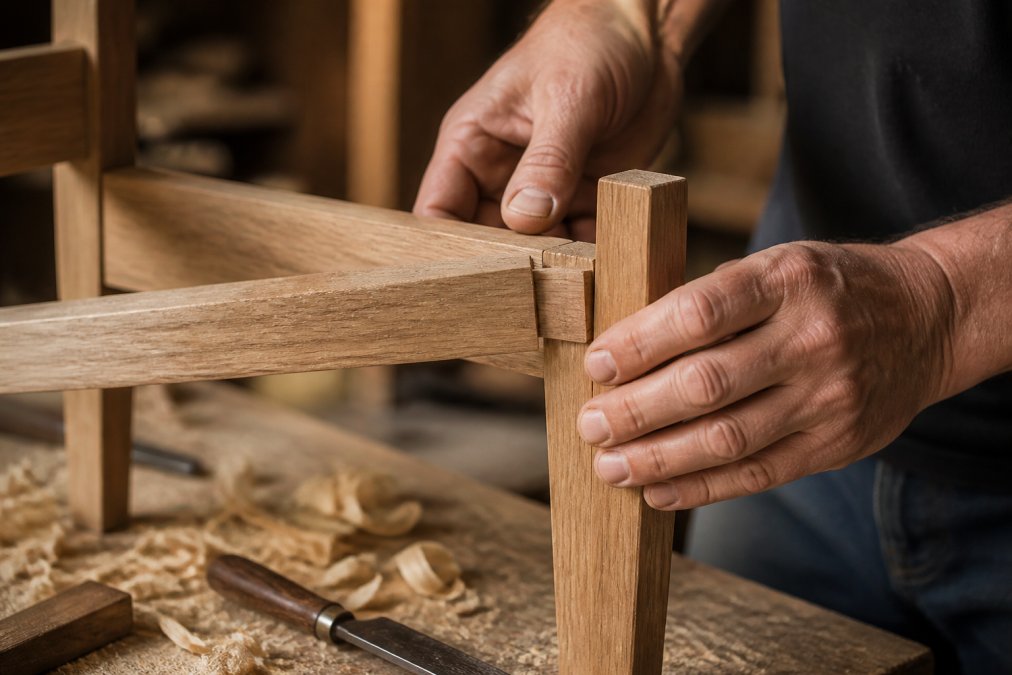
A mortise and tenon joint seats a cut tenon into a matching mortise, usually secured with a hardwood peg or hide glue. It resists racking and twisting far better than a screwed butt joint, and a furniture restorer can knock it apart, clean it and re-glue it decades later.
Look for a visible peg on the outside face of a leg or rail. That peg is often the tell.
Dovetail joints interlock in a trapezoidal pattern that resists pulling apart in any direction. Hand-cut dovetails show slight irregularity between pins; machine-cut versions are perfectly uniform. Neither is weak, but hand-cut work usually signals a maker who expects the piece to be opened and repaired.
Solid hardwood is the material foundation of heirloom furniture, because it can be sanded back, re-jointed and refinished. Engineered wood, veneer and particle board cannot be restored the same way once the surface layer fails.
The practical differences come down to how each material behaves over decades of seasonal movement:
Sourcing matters too. Forest Stewardship Council certification standards give buyers a verifiable chain of custody for timber, and low-VOC finishes reduce indoor emissions. For upholstered pieces, natural fibres and performance fabrics hold up better than budget synthetics, which pill and sag within a few years.
A useful test in the showroom: look at an exposed edge. Solid timber shows continuous grain running through the thickness. Veneer shows a thin face layer over a different substrate, and particle board shows a speckled, glued chip structure. That single glance tells you more about longevity than any finish.
Identifying high quality furniture takes about ninety seconds once you know where to look. Turn the piece over, check the joints, and test the weight.
Caring for heirloom furniture is mostly about controlling moisture and light. Timber moves with humidity, so stable indoor conditions prevent the cracks and joint failure that restoration cannot always reverse.
Monthly: dust with a dry, soft cloth. Skip silicone polishes, which build up and trap grit.
Every six months: apply a thin coat of quality furniture wax on sealed timber, buffing with the grain.
Continuously: keep pieces out of direct sun and away from heating vents. Aim for stable indoor humidity rather than a specific number.
Annually: check joints for movement and tighten or re-glue early. Small repairs stay small.
For genuine antiques, conservation guidance from the Smithsonian Museum Conservation Institute recommends reversible treatments only, so a future restorer can undo your work without damage.
Heirloom furniture is often cheaper over decades than fast furniture, even when the sticker price is several times higher. The maths is simple: divide cost by years of service, then add the costs that never appear on the price tag.
A worked comparison. Take a dining table used daily by a household.
The per-year gap narrows to the point where the heirloom piece is competitive, and the cheap option keeps generating costs the sticker price hides:
There is also an environmental ledger. Australian Bureau of Statistics waste accounts track the volume of furniture entering landfill each year, and much of it is composite board that cannot be recycled. Every piece kept in service for another decade is a piece diverted from that stream.
One of our in-stock pieces, the Venetian Gilded Mirror in Late 18th Century Style, is a useful example. At $6,250 it is hand-finished and unlikely to be replaced, which is the whole point of the calculation.

Fake heirloom marketing leans on vocabulary instead of construction. If a listing says "heirloom" but shows no joints, no timber species and no finish detail, treat the word as decoration.
Red flags:
The challenge is that "heirloom" is unregulated, so the word carries no guarantee. Oscar and Mila curates pieces that answer the question structurally, with solid hardwood construction, traditional joinery and hand-finished surfaces you can inspect and restore. Our collection includes designer mirrors, lighting and decor from makers such as Roberto Giovannini, alongside premium brands like Visual Comfort and Ralph Lauren. Get started with Oscar and Mila and furnish your home with pieces built to be passed down.
Heirloom furniture is built to last multiple generations, using solid wood, traditional joinery techniques like mortise and tenon or dovetail joints, and hand-finished surfaces. It resists trends and holds structural integrity for decades. Pieces such as a hand-finished gilded mirror or a hardwood dining table qualify because their construction and materials allow restoration rather than replacement, making them worth passing down.
No. Solid wood is a starting point, but heirloom quality also depends on joinery, finish quality, and material sourcing. A piece made from solid wood with screws and glue instead of traditional joints may still fail over time. Look for mortise and tenon or dovetail joints. Engineered wood and veneer can look good but rarely offer generational longevity.
Check the joints first: lift a chair by one leg, and if the frame twists, the joinery is weak. Look for dovetail drawers, mortise and tenon frames, and hand-finished surfaces. Examine the underside for particle board or staples. Quality furniture feels solid, has no wobble, and shows consistent finish quality across hidden areas.
Joinery determines how well a piece handles stress and movement over time. Mortise and tenon joints, used in traditional joinery techniques, distribute weight across the timber rather than relying on glue or screws. Dovetail joints lock drawers together mechanically. Furniture with these joints can be repaired and restored for generations, while stapled or screwed joints loosen within years, reducing heirloom value.
Leave a comment