


Last Updated: October 3, 2026
Quiet luxury lighting is the art of creating sophisticated, understated illumination that emphasises refinement over ostentation. Rather than commanding attention through bold designs or excessive brightness, quiet luxury lighting style works subtly to enhance a space's natural beauty and architectural integrity.
At Oscar and Mila, we understand that true luxury whispers rather than shouts. This philosophy underpins our curated collection of designer lighting pieces, where every chandelier, pendant, and fixture has been selected for its ability to transform a room through understated elegance.
The distinction between quiet luxury and conventional luxury lighting lies in intentionality.
Creating a truly luxurious interior requires more than a single statement piece. Layered lighting, combining ambient, task, and accent illumination, forms the foundation of sophisticated interior design. This approach allows you to control mood, functionality, and visual comfort throughout a space, which is essential to achieving the quiet luxury aesthetic.
Ambient illumination provides the foundational glow that makes a room feel welcoming without harsh glare. Task lighting supports specific activities like reading or working, whilst accent lighting highlights architectural features or artwork.
The architectural lighting design principles that underpin layered lighting emphasise balance and restraint. Rather than relying on a single overhead fixture, quiet luxury interiors use multiple light sources positioned at varying heights and intensities.
Natural materials form the visual and tactile foundation of quiet luxury lighting design. Brass fittings, alabaster shades, plaster finishes, and natural stone elements create a sense of authenticity and permanence that synthetic materials simply cannot replicate. These materials age beautifully, developing patina and character over time, which aligns perfectly with the quiet luxury philosophy of heirloom quality and longevity.
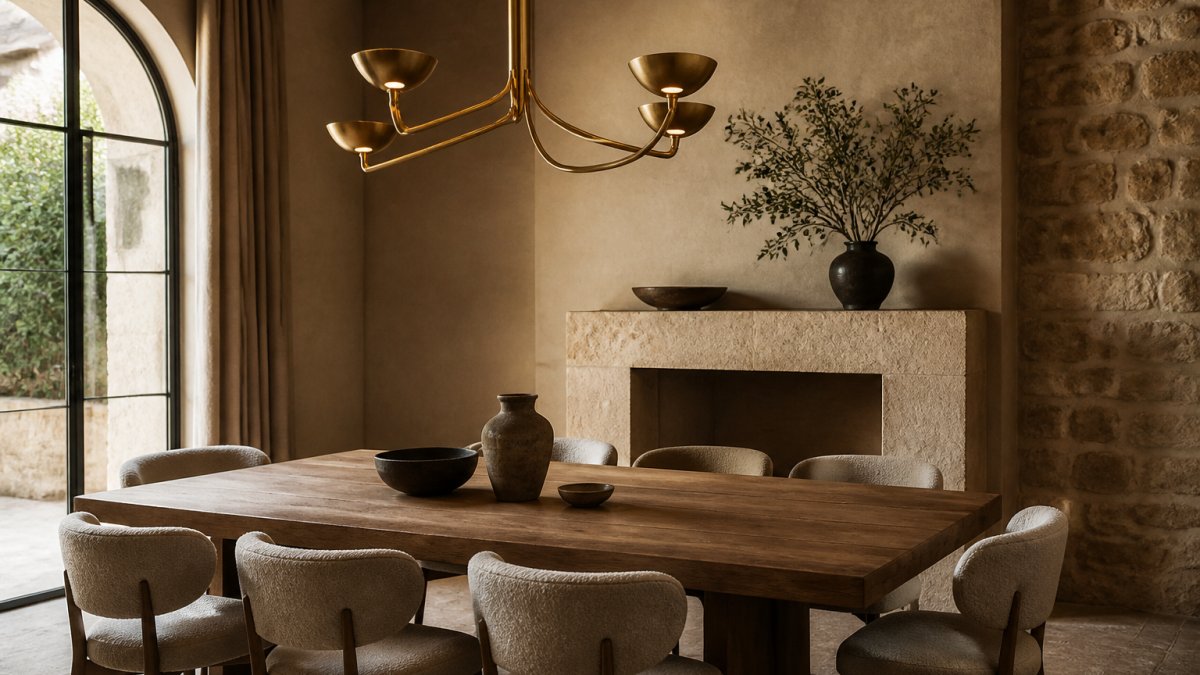
Warmth in quiet luxury lighting comes not from brightness but from colour temperature, measured in Kelvin (K). This is where many design guides fall short, they mention 'warm light' without specifying the precise ranges that define the quiet luxury aesthetic.
For quiet luxury interiors, target colour temperatures between 2200K and 2700K. This range is critical:
The AERIN Mollino series, available in antique brass with plaster white finishes, is typically calibrated to 2700K, exemplifying this approach.

When selecting fixtures, always verify the colour temperature specification. LED bulbs now offer precise Kelvin ratings, look for dimmable options in the 2200K-2700K range, as dimmable warm LEDs maintain their colour temperature even at reduced brightness levels, unlike some cheaper alternatives that shift toward cooler tones when dimmed.
Natural materials also contribute to visual comfort by diffusing harsh glare. Alabaster and plaster scatter light in soft, diffused ways that reduce eye strain and create a more pleasant visual experience. This diffused glow is a hallmark of quiet luxury lighting, as it allows people to feel comfortable in the space without the fatigue associated with bright, direct illumination.
Brass and bronze fittings warm light through their reflective properties, the metal itself absorbs and re-emits light in ways that enhance warmth perception. Matte finishes on brass diffuse light more subtly than polished finishes, making them ideal for quiet luxury schemes where the goal is to feel the light rather than see the source.
Architectural lighting design principles focus on how light interacts with the built environment to enhance form, texture, and spatial perception.
One core principle is using light to accentuate materiality. When a brass fitting catches warm light, or when plaster surfaces cast subtle shadows, the materials themselves become part of the visual narrative.
Minimalism plays a crucial role in architectural lighting design. The Chapman & Myers Connery 40" Ring Chandelier demonstrates this principle perfectly, its sleek minimalist design with a statement metal ring creates architectural interest through form rather than ornamentation, whilst the LED light reflected on the inner surface provides elegant, controlled illumination.

Shadow play is another essential principle often overlooked in conventional lighting design. Shadows create contrast, depth, and visual interest. In quiet luxury interiors, shadows are deliberately crafted to enhance the overall composition, whether through the sculptural form of a chandelier or the way light falls across textured surfaces.
Minimalist luxury lighting fixtures reject unnecessary ornamentation in favour of refined geometry and material excellence. Clean lines, understated forms, and carefully considered proportions characterise this approach.
The Chapman & Myers Connery series exemplifies minimalist luxury design. Available in both 30" and 40" sizes, with flush mount and chandelier options, the Connery's sleek architectural elements, its statement metal ring trimmed on top and bottom edges, create visual interest through form alone.
Minimalist fixtures often feature adjustable heights and clean canopy designs that disappear into the ceiling, allowing the light and the fixture's essential form to take centre stage. This approach aligns with the broader quiet luxury aesthetic, where restraint and intentionality matter more than visual drama.
Chapman & Myers Connery 40" Ring Chandelier →
Whilst minimalism forms the foundation of quiet luxury lighting, carefully selected statement pieces provide focal points that elevate a space. The key distinction is that these pieces should be inherently elegant rather than ostentatious.
The AERIN Mollino Large Tiered Chandelier represents the ideal statement piece for quiet luxury interiors. Suspended from a decorative chain, its lightweight tiered bowl in plaster white evokes 1930s French sculpture, creating a sophisticated visual presence in entryways, dining rooms, or hallways.

Diffused glow is essential to creating visual comfort in luxury interiors. Rather than direct, harsh illumination, diffused light scatters across surfaces, creating a softer, more pleasant visual environment. Plaster and alabaster materials naturally diffuse light, as do fabric shades and frosted glass.
Contemporary quiet luxury lighting increasingly incorporates smart lighting technology and sustainable design principles without compromising aesthetic refinement. The key is integration that remains invisible, technology should serve the atmosphere, not announce itself.
Dimmable fixtures are essential to quiet luxury design because they allow you to adjust colour temperature and intensity throughout the day whilst maintaining the sophisticated atmosphere. Modern smart dimmers enable:
The Chapman & Myers Connery 40" Ring Chandelier, when paired with a dimmable LED driver, allows seamless intensity adjustment without colour shift, critical for maintaining the refined glow that defines the style. Many luxury fixtures now integrate with standard smart home platforms, though always verify compatibility before purchase.
Quiet luxury lighting strategy varies significantly by room function. Smart systems allow you to optimise each space:
Bedrooms: Target 2200K-2400K at 30-50% brightness in the evening to support melatonin production. Smart scheduling can gradually dim fixtures between 9 PM and midnight, signalling the body to prepare for sleep. Morning scenes should warm up slowly to avoid harsh awakening.
Dining Rooms: Maintain 2700K at 60-80% brightness for entertaining, dropping to 40-50% for intimate dinners. Smart dimmers allow guests to experience the same refined ambience regardless of external daylight conditions.
Living Rooms: Layer ambient (via statement chandelier or ceiling fixture), task (reading lamps), and accent lighting (architectural uplighting).
Kitchens and Work Areas: Quiet luxury kitchens often use under-cabinet task lighting at 2700K-3000K for food preparation, paired with ambient ceiling fixtures at 2700K for general living. Smart control allows you to isolate task lighting when cooking without affecting the broader room ambience.
Entryways and Hallways: A single statement piece (like the AERIN Mollino) benefits from smart dimming that adjusts based on time of day.
Sustainability in quiet luxury design emphasises longevity and timelessness. High-quality LED bulbs now deliver warm, high-quality light whilst consuming 75-80% less energy than traditional incandescent bulbs. More importantly, premium LEDs last 25,000-50,000 hours (roughly 10-20 years of typical residential use), meaning you replace bulbs far less frequently.
When selecting LEDs for quiet luxury fixtures:
The most sustainable lighting is lighting that lasts. Quiet luxury fixtures crafted from durable natural materials, solid brass, cast plaster, natural stone, are designed to outlast trends and technological obsolescence. A brass chandelier from the 1930s can still function beautifully today; a plastic fixture from 2010 is likely destined for landfill.
Invest in pieces where material quality justifies longevity. Brass develops a rich patina over decades; plaster and stone age gracefully. This heirloom approach represents a fundamental shift away from disposable, trend-driven furnishings towards pieces that improve with age and use. Paired with modern LED technology and smart controls, these timeless fixtures become both environmentally responsible and economically sensible, the cost per year of ownership decreases significantly over a 15-20 year lifespan.
Quiet luxury lighting prioritises understated sophistication over ostentation. It combines layered illumination with natural materials like alabaster, brass, and stone, soft neutral tones, and diffused glow rather than harsh brightness. The focus is on creating atmospheric comfort through thoughtful design, pieces that whisper elegance rather than announce it. Statement chandeliers exist, but they're sculptural and refined, often inspired by mid-century or classical forms. Dimmable fixtures and warm colour temperatures (around 2700K) are essential, allowing you to adjust mood throughout the day.
Traditional luxury often emphasises size, sparkle, and visible opulence, crystal chandeliers, bright white light, and ornate details. Quiet luxury rejects this approach entirely. Instead, it embraces minimalism, architectural integrity, and tactile materials that feel heirloom-quality. The lighting itself becomes part of the interior architecture rather than a decorative accent. Quiet luxury favours shadow play, accent lighting that highlights architectural features, and warm uplight that creates subtle depth. It's about curated aesthetic and visual comfort, not displaying wealth.
Yes, but strategic choices matter. Focus on layered lighting first: affordable ambient fixtures combined with task and accent lighting create sophistication without expense. Natural materials like brass and plaster finishes can be found at mid-range price points. Prioritise one or two statement pieces, such as a sculptural pendant or architectural sconce, rather than filling every corner with designer fixtures. Dimmable LED bulbs are affordable and essential for mood control. Consider vintage or second-hand pieces with heirloom quality; these often embody quiet luxury better than new mass-produced alternatives.
Warm colour temperatures are non-negotiable for quiet luxury. Aim for 2700K (warm white) or lower for ambient and accent lighting; this creates the soft, atmospheric glow that defines the aesthetic. Task lighting can go slightly cooler (3000K) if needed for functionality, but keep it subtle. Avoid anything above 4000K, which produces harsh, clinical light that contradicts quiet luxury's emphasis on visual comfort and mood. Dimmable fixtures let you lower intensity further in the evening, deepening warmth and creating intimate shadow play that transforms a room's atmosphere.
Leave a comment