


Last Updated: September 12, 2026
Luxury home decor rewards restraint, and in a small space, restraint is structural. Beautiful objects bought in isolation are often crowded together until the room feels smaller than it did empty. The fix starts before you spend anything.
Measure every wall, note door swing arcs, and mark power points and windows on a simple floor plan. Then decide what the room must do: sleep, entertain, work, or all three. Only after that do you choose pieces.
Walk the room with a tape measure and a phone. Record wall lengths in millimetres, ceiling height, and the depth of your largest existing item. Note where morning light falls and where it fades by mid-afternoon.
Then rank your needs in three tiers:
A common mistake is buying tier-three items first because they are easy to love online. They arrive, and there is nowhere for the sofa.
Scale, not price, decides whether a room reads as sophisticated or cramped. A large room tolerates large furniture; a small one needs pieces sized to its actual dimensions, not to a showroom floor.
Start with the largest item and work down. In a compact living room, a two-seater with slim arms will almost always beat a bulky three-seater. Leave at least 45cm of walkway between furniture groups, and pull seating slightly away from walls so the room breathes.
Think of your visual space as a budget. Roughly 70 per cent should be quiet, cohesive design: neutral upholstery, plain walls, considered negative space. The remaining 30 per cent carries the drama, whether that is a sculptural floor lamp, a textural rug, or one bold artwork.
Break the rule and every object competes for attention. Follow it and a single statement piece reads as intentional rather than accidental.
| Room Size | Seating Depth | Walkway Minimum | Statement Pieces |
|---|---|---|---|
| Under 15 sqm | 75-85cm | 45cm | 1 |
| 15-25 sqm | 85-95cm | 60cm | 2 |
| 25-40 sqm | 95-100cm | 75cm | 2-3 |
Statement lighting does more work in a small room than in a large one, because it defines zones without adding floor footprint. A wall sconce, a slim pendant, or a sculptural table lamp can separate a reading corner from a dining nook without a single partition.
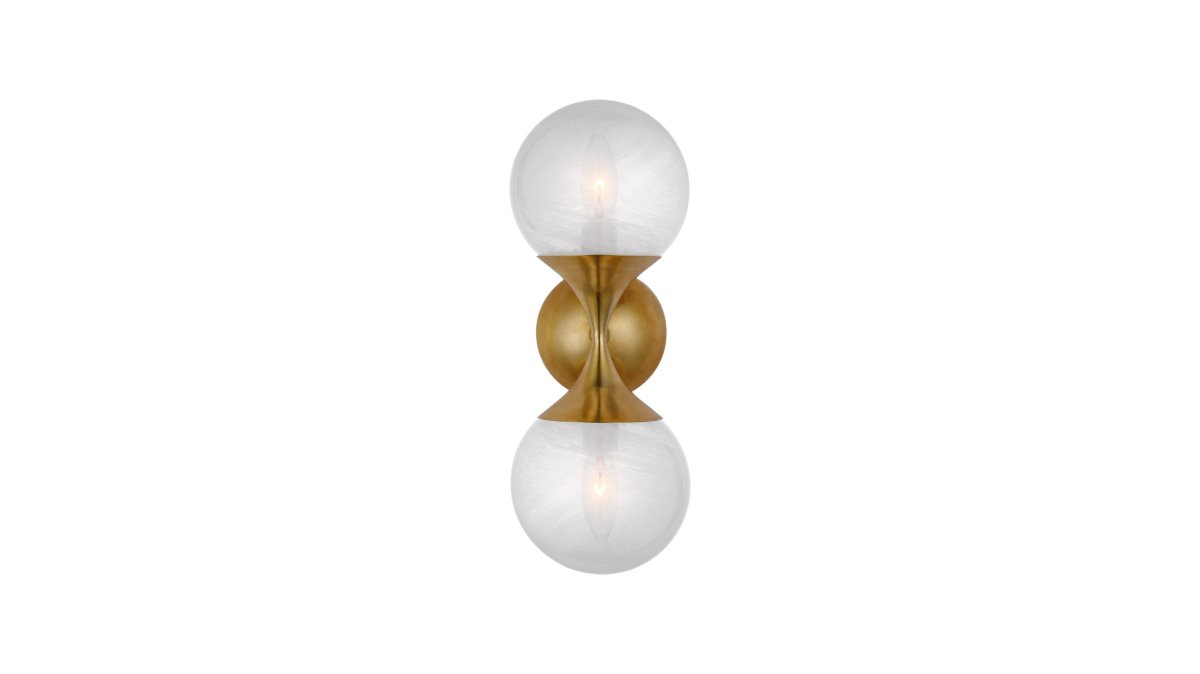
Wall-mounted options suit compact rooms best. The Visual Comfort AERIN Cristol Small Double Wall Sconce, at $1,050.00, was designed for exactly this problem: dressing rooms and hallways where a ceiling fixture would overwhelm the space. Its white glass orb and fluted brass base cast a warm, contained glow.

One ceiling light flattens a room. Three layers give it depth.
In a small space, dimmers matter more than wattage. Being able to drop ambient light to 20 per cent while accent lights stay warm is what separates a hotel-lobby feel from a waiting-room feel (lightingcouncil.com.au).
Mirrors are the cheapest square metreage you will ever buy. A well-placed mirror does not just reflect a room; it doubles the perceived depth of the wall it sits on, and it bounces natural light into corners that would otherwise stay dim (PubMed).
Placement matters more than size. Hang a mirror opposite or adjacent to a window, never facing a blank wall. In narrow hallways, a round mirror breaks the tunnel effect. Above a console, it lifts the eye and makes a low ceiling feel higher.
The Clarendon Round Mirror, at $895.00, is a good example of a piece doing double duty: bevelled edges and ornate orbs on a burnt gold frame make it a statement in its own right, while the reflective surface still does the spatial work. For a softer, more understated option, the White Round Beaded Mirror at $375.00 measures 90cm in diameter and suits a hallway nook or a dressing table without dominating either.

Avoid clustering multiple mirrors in one sightline. Two is plenty in a small room; three starts to feel like a funhouse.
Quiet luxury interior design trends favour material honesty over logos, and this suits small spaces perfectly. When a room cannot rely on sheer size to impress, it has to rely on texture, finish, and proportion instead.
The direction for quiet luxury interior design trends leans toward warm neutrals with depth: bone, mushroom, clay, and soft charcoal rather than stark white. Textural contrast carries the interest, so a boucle armchair beside a smooth plaster wall and a brushed brass sconce reads richer than three patterned fabrics fighting each other.
Curated aesthetic matters more than accumulation. Buy fewer pieces, and buy ones with a clear point of view. A single well-chosen accent piece will do more for a compact room than five mid-tier objects that each almost work.
Bespoke joinery solves the problem off-the-shelf furniture cannot: it fits the room you actually have. A custom-built bench that spans an awkward alcove, or a wall unit that stops precisely at the cornice, uses space that a standard cabinet leaves stranded. In a compact room, that reclaimed centimetreage is often the difference between a room that works and one that merely fits.
The trade-off is lead time and cost, and it is worth being honest about both. Off-the-shelf pieces arrive faster and cost less; bespoke pieces fit better and last longer. A common pattern among designers working on compact footprints is to reserve bespoke joinery for the two or three zones where standard sizing fails, a return wall, a window reveal, a stair void, and buy retail for everything else. For a room you intend to keep for a decade, the maths usually favours bespoke. For a rental or a short-term staging job, it rarely does.
Ask your joiner three questions before you commit: what is the confirmed lead time in writing, what substrate and finish are specified, and how will the unit be scribed to uneven walls. Older terraces and apartments rarely have true corners, and a unit that assumes square walls will show a gap.
Most small-space guides stop at "choose quality materials" without saying where they come from. For a compact room, material honesty does more work than pattern, because there is less surface area to hide behind.
For a compact room, material honesty does more work than pattern, because there is less surface area to hide behind.
Acoustic comfort is the quiet luxury most small homes miss entirely. Hard surfaces bounce sound, and in a compact room with timber floors, glass and plaster, conversation echoes in a way that undercuts the sense of calm. The smaller the room, the shorter the reverberation distance, so the effect is more pronounced, not less (PubMed).
The fix is soft furnishing and surface treatment:
None of it reads as "design", and all of it changes how the room feels. In a small space, calm is a material decision as much as a visual one.
The best luxury home decor online stores solve three problems at once: authenticity, lead time, and whether the piece will actually suit your space. Price alone tells you very little, and in a compact room a wrong-scale piece is more costly than a wrong-price one, because there is nowhere to hide it.
A short, repeatable checklist beats browsing. Before committing to any high-ticket piece online:
A boutique model can offer a curated selection. Where a large quantity of identical items or a single supplier for an entire project is needed, a large-format retailer may be more suitable.
For interior designers and trade professionals, practical questions often include confirming provenance, delivery windows, and the breadth of the range. Inquire about trade pricing and consolidated freight options, and whether stock can be held against a project timeline.
Small rooms punish ordering errors more than large ones, so treat the returns policy as a design constraint, not a footnote. Measure the delivery path as well as the room: a sofa that fits the wall may still not clear a stair turn or a lift door. Where a piece is made to order, returns policies may vary, so confirm the specification before you sign off.
Small spaces expose every decision you make about scale, light, and restraint, which is why they reward a slower, more deliberate approach to buying. Oscar and Mila curates high-end designer furniture, lighting, and mirrors for exactly this kind of considered home, with pieces from premium brands such as Visual Comfort and Ralph Lauren across interior and exterior ranges. Start with a spatial plan, layer your lighting, and let one statement piece do the work of five. Browse the Oscar and Mila collection to find pieces sized and finished for the room you actually have.
The 70/30 rule suggests filling roughly 70 per cent of a room with furniture and leaving 30 per cent as open floor space. In small rooms this ratio matters more, because a single oversized sofa can make a space feel cramped. Measure your floor plan, mark out where each piece will sit, and keep walkways at least 60cm wide. If a piece pushes you past that 70 per cent mark, it is the wrong scale regardless of how beautiful it is.
Start with ceiling height and function. A wall sconce like the Visual Comfort AERIN Cristol Small Double Wall Sconce, priced at $1,050, suits hallways and dressing rooms where a pendant would crowd the space. Layer ambient light from a ceiling fixture with task lighting from a floor lamp and accent light from a table lamp. Choose one statement piece and keep the rest understated so the room reads as curated rather than busy.
Place a large mirror opposite or adjacent to a window so it reflects natural light and doubles the perceived depth. A round mirror works well above a console or in a hallway nook. The Clarendon Round Mirror at $895, with its bevelled edges and burnt gold frame, adds a classic statement without overwhelming a narrow space. Avoid clustering multiple mirrors on one wall, as this creates visual noise rather than expansion.
Quiet luxury favours restraint over logos. Think neutral colour palettes in warm whites, stone and taupe, natural materials like linen, wool and timber, and one or two statement pieces rather than many. A hand-finished mirror, a sculptural lamp or a textured throw can carry a room. The look relies on craftsmanship you can feel, not branding you can see, which suits small spaces where every object is on display.
Leave a comment