


Last Updated: September 28, 2026
Getting the size wrong is the single most common and most expensive mistake in rug buying. A luxury rug that is too small makes even generous rooms feel disjointed, while a correctly scaled piece anchors the entire living room layout. This luxury rug size guide starts with the room itself, not the rug.
Measure the full length and width of your living room first, then measure the footprint of your main seating group: sofa, armchairs, and coffee table. The rug should extend at least 20 cm beyond the front edge of every seat. In an open-plan living space, use the rug to define the sitting zone rather than covering the whole floor.
The front legs rule is the most reliable placement technique in interior design: all main furniture sits with its front legs on the rug, while back legs stay on the bare floor. For larger rooms, place the entire seating group on the rug so it reads as one cohesive zone. In narrow rooms, run the rug lengthways to create spatial flow.
| Room Size | Recommended Rug Size | Placement Approach |
|---|---|---|
| Small (under 3 x 4 m) | 200 x 300 cm | Front legs on rug |
| Medium (4 x 5 m) | 250 x 350 cm | Entire seating group on rug |
| Large / open-plan (5 x 6 m+) | 300 x 400 cm or larger | Full group plus walkway margin |
Material choice determines how a designer rug ages, not just how it looks on delivery. Wool remains the benchmark for living rooms because its natural crimp resists crushing and hides footfall marks. Silk and viscose add sheen but demand gentler treatment. Durability comes down to fibre, weave density, and where the rug actually sits.
Natural fibres include wool, silk, jute, sisal, and viscose, each with distinct hand-feel and wear characteristics. Wool handles high-traffic areas best, jute and sisal offer textural contrast at lower cost, and silk brings lustre to low-traffic zones. Synthetic materials such as polypropylene resist stains and moisture but rarely match the depth of hand-knotted wool or silk.
Weave density, measured in knots per square metre, is the clearest indicator of longevity in a hand-knotted rug. Higher density means a firmer, more resilient surface that holds its shape for decades. Pile height affects both feel and maintenance: a plush pile feels luxurious underfoot, while a flatweave suits dining-adjacent living zones.
Styling a luxury rug with designer furniture is a question of visual weight and proportion, not colour matching. The rug is the largest single surface in the room, so it sets the visual floor line that every other piece is read against. Get that line wrong and even a well-curated room feels unresolved.
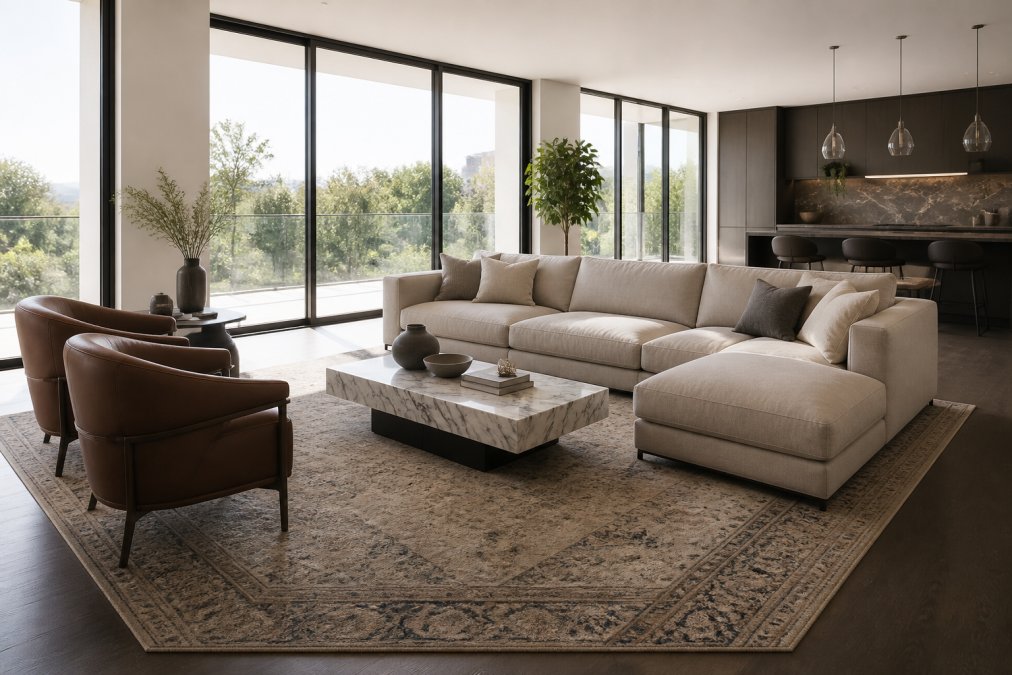
Visual weight is the perceived mass of a piece, driven by colour value, texture, and silhouette. A low-profile sofa in a mid-tone fabric reads lighter than a deep-buttoned leather chesterfield, even at the same physical size. The rug needs to carry slightly more visual weight than the heaviest piece in the seating group, or the furniture appears to float.
Texture pairing follows a simple contrast rule. Smooth, reflective finishes, polished marble, lacquered timber, glass, brushed brass, sit best on a dense, matte wool or wool-blend pile, because the rug absorbs the reflection and stops the room reading as cold. Rough, matte finishes, raw timber, bouclé, linen, unglazed ceramic, sit best on a rug with some sheen or variation, such as a silk-blend or a hand-knotted piece with abrash (the natural colour variation in hand-dyed wool).
Leave at least 20 cm of bare floor between the rug edge and any wall, and at least 20 cm between the rug edge and the nearest large piece of furniture that sits off the rug. This gap is what makes a rug read as a deliberate zone rather than wall-to-wall carpet.
Layering is the most underused styling technique in luxury living rooms. A smaller, finer rug placed over a larger neutral base adds textural contrast and lets you rotate a statement piece seasonally without replacing the foundation. The base rug should extend at least 30 cm beyond the top rug on every side, and the top rug should be thin enough that it does not create a trip hazard at the edge.
The most common styling error is choosing a rug that competes with a statement sofa rather than grounding it. If the sofa is the focal point, the rug should be the quietest element in the room. The second most common error is matching the rug exactly to the sofa fabric, the room reads as a set rather than a curated space.
Colour and pattern should serve the interior design aesthetic you have already committed to, not introduce a new one. The rug is the largest colour field in the room, so it amplifies whatever palette is already present. Choose it last, after walls, upholstery, and artwork are settled.
Rug colour shifts dramatically between a showroom and a living room, and between morning and late afternoon. Most practitioners recommend living with a sample for at least three days before committing. Place an A3-sized sample flat on the floor, not held up against a wall, and check it at three times: mid-morning, late afternoon, and under artificial light in the evening.
Key mechanisms to watch for:
Pattern scale should be proportional to the room, not to the rug. A small, dense pattern on a large rug in a large room reads as visual noise from across the space; a large, bold pattern on a small rug in a small room overwhelms the furniture.
Pull one or two colours from your existing palette rather than introducing a third. A rug that echoes the wall tone makes a room feel larger; a rug with strong contrast creates a deliberate focal point. For decor cohesion, let the rug be the quietest element in a busy room and the anchor in a minimal one.
Rug layering and underlay are the two most overlooked upgrades in luxury rug ownership. Layering means placing a smaller, finer rug over a larger, neutral base, which adds textural contrast and lets you rotate statement pieces seasonally. The base rug should be at least 30 cm larger on every side.
Most rug mistakes are scale and placement errors, not style errors. Buy the size that fits the room, then choose the design. A rug that is too small is the fastest way to make an expensive piece look cheap.
Choosing a luxury rug is a decision about scale, fibre, and longevity, not just colour. Get the size and placement right first, then let material and pattern follow the room you already have.
Start with the room's dimensions and furniture footprint, then choose a size that lets at least the front legs of your seating sit on the rug. Match the material to traffic: wool and hand-knotted blends handle daily use, while silk and viscose suit low-traffic zones. Finally, pick a colour palette that either grounds or lifts your existing decor. A luxury rug should feel like part of the room, not an afterthought.
Wool is the benchmark for high-traffic areas because its natural crimp resists crushing and hides footprints. Hand-knotted wool with a dense weave lasts decades. Wool-silk blends add sheen without sacrificing durability. Jute and sisal work well in casual or coastal schemes but feel rougher underfoot. Viscose looks luxurious but shows crushing and water marks, so keep it in low-traffic zones or formal living rooms.
For a large living room, measure the seating zone rather than the whole floor. A common rule is to choose a rug that extends at least 20 to 30 centimetres beyond the front legs of your sofa and chairs on all sides. In open-plan layouts, use the rug to define the conversation area. If in doubt, size up: a rug that is too small makes even a generous room feel disjointed.
Neither is automatically correct. A lighter rug opens up a dark sofa and adds contrast; a darker rug grounds a pale sofa and hides marks in busy households. What matters is visual weight and spatial flow. In a small room, a rug close to the floor tone makes the space feel larger. In a large room, a contrasting rug creates a focal point. Test the direction against your wall colour before committing.
Leave a comment