


Last Updated: September 14, 2026
Choosing the right material for a high-end outdoor furniture comparison in Australia comes down to how each handles salt air, intense UV and seasonal humidity. Teak offers warmth and ages gracefully with oiling; marine-grade aluminium and powder-coated steel resist corrosion with minimal upkeep; HDPE wicker and polypropylene resin deliver all-weather performance without the maintenance load. At Oscar and Mila, we curate pieces across all three categories.
Here is how the main outdoor furniture materials stack up:
| Material | Best For | Maintenance | Coastal Suitability |
|---|---|---|---|
| Teak | Alfresco dining, covered decks | Regular oiling | Good (covered) |
| Marine-grade aluminium | Full-sun, salt-exposed patios | Occasional wash | Excellent |
| Powder-coated steel | Structured frames, dining sets | Occasional wash | Very good |
| HDPE wicker | Lounge settings, low upkeep | Rinse as needed | Excellent |
| Polypropylene resin | Side tables, accents | Wipe down | Very good |
If you want the short answer: marine-grade aluminium and HDPE wicker are the lowest-effort choices for exposed coastal positions, while teak rewards those willing to oil it.
Teak and aluminium sit at opposite ends of the spectrum: teak is a natural hardwood prized for grain and warmth, aluminium an engineered metal chosen for lightness and corrosion resistance.
Teak is a dense tropical hardwood that develops a silver-grey patina untreated, or holds a golden tone when oiled. Its natural oils make it more moisture-resistant than most timbers.
The trade-off is upkeep: a teak table needs re-oiling, and solid-top designs are best kept under cover. Our Normandy Rectangle Dining Table, hand-carved from Brazilian teak and finished with a grey oil, carries a two-year warranty and is designed for alfresco or covered-deck use rather than full exposure.

Aluminium is the practical choice for exposed positions: it does not rust, is light enough to rearrange single-handed, and a powder-coated finish adds colour and UV resistance.
Where aluminium falls short is feel: it lacks the visual warmth of timber, and lightweight frames can shift in strong wind unless weighted or anchored. For most buyers, the decision comes down to how much maintenance they want to take on.
The best material for harsh climates is marine-grade aluminium or HDPE wicker, both of which resist salt spray, UV degradation and moisture without constant attention. Teak performs well when covered; powder-coated steel is a strong second tier for structured frames.
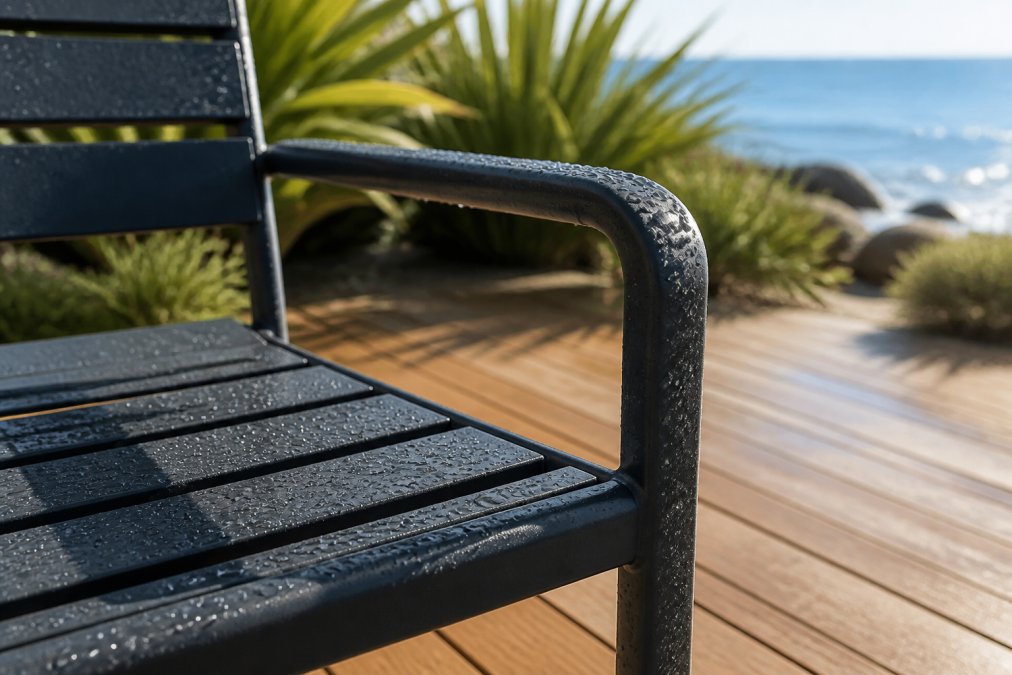
Marine-grade aluminium is alloyed to resist corrosion in salt-laden air, making it the benchmark for coastal conditions. Its naturally forming oxide layer self-heals when scratched, so unpainted marine-grade aluminium can be left bare in salt air. Powder-coated steel offers comparable finish quality, but its protection is passive: once the coating is breached, rust begins immediately.
In coastal installations the base metal matters more than the coating: a 6061 or 6063 marine-grade aluminium frame with a modest powder coat will outlast a heavily coated mild-steel frame, because aluminium fails slowly through surface oxidation while steel fails quickly once moisture reaches the substrate. Look for the alloy designation or the words "marine-grade" or "galvanised" on the specification, not just the finish colour.
Our California Outdoor Setting uses a galvanised, powder-coated metal frame to prevent corrosion, hand-woven with recyclable synthetic materials. The Bronte Outdoor Armchair follows the same approach in a powder-coated aluminium frame, with fade-resistant weave and 100% polyester upholstery rated for outdoor use.


HDPE wicker is a synthetic weave engineered to resist fading, moisture and salt without the brittleness of older PVC-based weaves. HDPE has a saturated carbon chain that UV stabilisers protect effectively, whereas PVC releases chlorine under sustained UV and embrittles (pubmed.ncbi.nlm.nih.gov). Polypropylene resin serves a similar role in moulded table tops and accents, though it is slightly less UV-stable and best kept to shaded or semi-exposed positions.
Neither material needs oiling or sealing: a fresh-water rinse removes salt and dust, and colourfastness holds up under sustained sun. The limitation is repairability, a damaged weave strand is hard to match invisibly.
Three physical processes decide how a material performs in an Australian coastal or inland setting.
Salt-air corrosion. Airborne chloride deposits on metal surfaces and, with moisture, accelerates the electrochemical reaction that consumes base metal. Marine-grade aluminium and HDPE are effectively immune; powder-coated steel is protected only while the coating is intact. Teak is unaffected by chloride, but its oil can be leached by repeated salt exposure, which is why covered positions suit it best.
UV degradation. Sustained ultraviolet exposure breaks polymer chains in plastics and fades pigments in coatings and fabrics. HDPE with a quality UV stabiliser package and solution-dyed acrylic or polyester fabrics resist this best; powder coating eventually dulls. Untreated teak silvers, cosmetic, not structural, while oiled teak holds its tone but needs re-oiling more often in full sun.
Thermal cycling. Daily expansion and contraction stresses joints, welds and coating edges. Aluminium moves more than steel with temperature, so well-designed frames use welded or mechanically locked joints. Timber moves least along the grain and most across it, which is why solid teak tops usually use floating or breadboard ends.
Specify from exposure rather than aesthetics:
A luxury outdoor furniture maintenance guide is less about effort than rhythm: the right task at the right interval prevents most long-term damage.
Our Elana Side Table illustrates a mixed-material piece: a composite resin top with a powder-stone finish on a powder-coated iron shaft, maintained with a simple sealant coating rather than ongoing treatment.
Coastal positions demand more frequent attention because salt spray accelerates corrosion and dulls finishes faster. Inland settings face intense UV and dry heat, which fade fabrics and dry out timber.
A practical seasonal routine looks like this:
Repairability, weight-to-stability and chemical compatibility are the three factors most buyers never consider until something goes wrong.
Teak is the most repairable material here: scratches sand out and a full refinish is possible. Powder-coated metal sits in the middle, chips can be touched up, but a bent frame is hard to straighten. HDPE wicker is least repairable, since a damaged strand rarely matches the surrounding weave.
Weight-to-stability ratio describes how much mass a piece needs to stay put in wind. Aluminium is light, an advantage for rearranging, a liability in exposed positions unless weighted or anchored. Teak and resin-composite tables stay put unaided.
Chemical compatibility matters for cleaning: harsh solvents can dull powder coating, strip teak oil or cloud resin finishes. Mild soap and fresh water handle almost every situation; save aggressive products for stubborn marks only.
Lifecycle carbon footprint is the total emissions a piece generates from raw material extraction through manufacturing, transport and end-of-life disposal. Most outdoor furniture comparisons ignore it, yet it changes the verdict for buyers who care about longevity: outdoor furniture is one of the few categories where the use phase, decades of service, can outweigh the manufacturing phase, because a piece that lasts twenty years amortises its embodied carbon across a far longer life than one replaced every three years.
Embodied carbon is the emissions locked into a material before it reaches your deck. The relative ranking is well established in life-cycle assessment:
Because exact numbers depend on the supply chain, no material wins outright. What matters is the combination of recycled content, transport distance and service life.
The most useful comparison is embodied carbon divided by expected service life. A teak table with a high upfront footprint that lasts thirty years can have a lower annual carbon cost than a cheaper composite table replaced three times over. Likewise, a marine-grade aluminium frame that survives twenty coastal summers outperforms a mild-steel frame that rusts through in five.
This is why sustainability and durability are the same conversation: every additional year of service spreads embodied carbon thinner.
Sustainable sourcing comes down to asking the right questions:
Aluminium and steel are among the most recycled materials on earth and retain value at end of life, so metal frames are rarely landfilled. HDPE is recyclable but collection infrastructure varies, so a take-back scheme matters. Teak can be refinished, repurposed or composted. The least circular outcome is a mixed-material piece that cannot be separated.
The hardest part of specifying high-end outdoor furniture is matching teak, aluminium, steel, wicker and resin to your site's exact conditions, then committing to the maintenance rhythm each requires. Get that match right and the furniture outlasts the deck it sits on.
Oscar and Mila curates designer outdoor furniture, lighting and decor for interior and exterior spaces, with pieces built around the materials this guide covers, teak dining tables, powder-coated aluminium and wicker settings, and mixed-material side tables, each selected for craftsmanship rather than volume. If you want guidance on which material suits your position, get started with Oscar and Mila and build an outdoor setting that holds its finish for years.
There is no single best material, but marine-grade aluminium and high-density polyethylene (HDPE) wicker perform exceptionally well in Australian conditions. Marine-grade aluminium resists rust and salt spray, while HDPE wicker handles UV exposure without fading. Teak is another strong option if you commit to regular oiling. For coastal areas, powder-coated aluminium and synthetic weaves offer the lowest maintenance. For a classic look, teak remains a popular choice. Ultimately, the right material depends on your climate, maintenance willingness and style preference.
Teak offers natural warmth and a timeless aesthetic, but requires oiling to maintain its colour and prevent drying. Aluminium is lightweight, rust-proof and needs minimal upkeep, making it ideal for coastal or low-maintenance settings. In the teak vs aluminium outdoor furniture comparison, teak suits covered alfresco areas where its grain can be admired, while aluminium thrives in exposed positions. Both are durable, but aluminium typically costs less over time due to lower maintenance. Your choice should align with your design vision and how much care you are willing to provide.
High-density polyethylene (HDPE) wicker and solution-dyed acrylic fabrics are top performers for UV resistance. These materials are engineered to resist fading and degradation from prolonged sun exposure. Powder-coated aluminium also holds up well, though the coating can chalk over many years. Teak develops a silver-grey patina when exposed to UV, which many consider attractive but changes its original colour. For pieces that will sit in full sun, synthetic weaves and UV-stabilised fabrics are your best bet. Regular cleaning helps maintain their appearance.
Maintenance varies by material. Teak needs oiling every 3-6 months to preserve its golden hue; if left untreated, it will weather to a silver-grey. Aluminium and powder-coated steel require occasional washing with mild soap and water to remove salt and dirt. HDPE wicker can be hosed down and wiped with a damp cloth. Cushions should be brought inside during harsh weather and cleaned according to the fabric care label. For all materials, inspect joints and fasteners seasonally and address any scratches or chips promptly to prevent corrosion.
Premium synthetic weaves, such as HDPE wicker, offer superior UV resistance, moisture resistance and colourfastness compared to natural materials like teak or rattan. They do not crack, rot or fade as easily, and they require less maintenance. However, natural materials provide a unique tactile warmth and organic beauty that synthetics cannot fully replicate. For harsh climates with intense sun and salt spray, synthetic weaves are often the more practical choice. For a traditional, high-end look in a protected area, natural teak remains a favoured option.
Leave a comment