


Last Updated: September 2, 2026
A mirror in your entryway is the first architectural statement visitors encounter. The right placement transforms a cramped hallway into a space that feels larger, brighter, and intentionally curated. A mirror positioned at eye level creates an immediate focal point that draws viewers into the space. When paired with appropriate lighting and styling, mirrors become active design elements rather than afterthoughts.

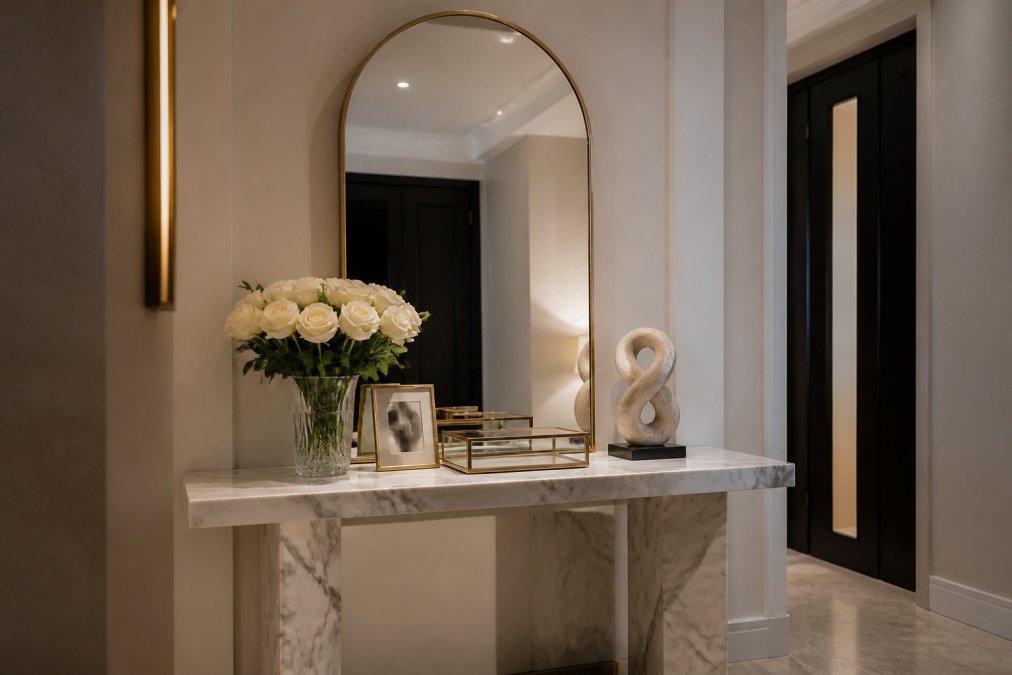
Strategically placed mirrors reflect natural light, amplify ambient lighting, and create depth perception that makes narrow hallways feel less confining. The frame finish, shape, and relationship to surrounding decor all influence whether a mirror enhances or overwhelms a small entryway. Interior design principles for small spaces emphasise that mirrors are among the most powerful tools for visual expansion in compact areas.
The shape of your mirror determines whether it anchors your entryway or competes with other elements. Round mirrors soften sharp lines and create visual flow. Arched mirrors introduce classical elegance and work particularly well above console tables. Rectangular mirrors suit minimalist designs. Octagonal mirrors, such as the Octagonal Mirror in Silver-Leaf at $375, offer geometric interest without sharp corners.
Size is equally critical. A mirror that's too small fails to create spatial illusion; one that's too large dominates the space. The ideal mirror should occupy roughly 30-40% of the wall space above your console table. For narrow hallways, a full-length mirror positioned strategically near the entry creates both functionality and expanded space.
Arched mirrors evoke classical architecture and work beautifully in luxury entryways with traditional or transitional styling. Round mirrors offer modern sophistication and pair exceptionally well with contemporary console tables. The choice depends on your existing interior styling and the visual balance you want to achieve.
The Clarendon Round Mirror in Burnt Gold ($895) exemplifies how shape and finish work together. Its bevelled edges and ornate detailing create a statement piece that functions as both mirror and sculptural art. The round form prevents the frame from appearing too formal, while the luxurious finish ensures it reads as a curated design choice.

A full-length mirror serves dual purposes: it's practical for appearance checks and a powerful design tool for creating depth perception. Full-length mirrors positioned near the entry make narrow hallways feel less confining and reflect light across a larger surface area, amplifying the effect of natural and artificial lighting.
In small luxury entryways, full-length mirrors force intentional styling. They demand that you think about what the mirror reflects, the wall behind it, the lighting above it, and surrounding objects, pushing you toward visual coherence rather than random accumulation.
A console table beneath a mirror creates the architectural foundation for your entryway's focal point. The console provides a stage for styling and layering objects while the mirror above becomes a frame that enhances the tableau.
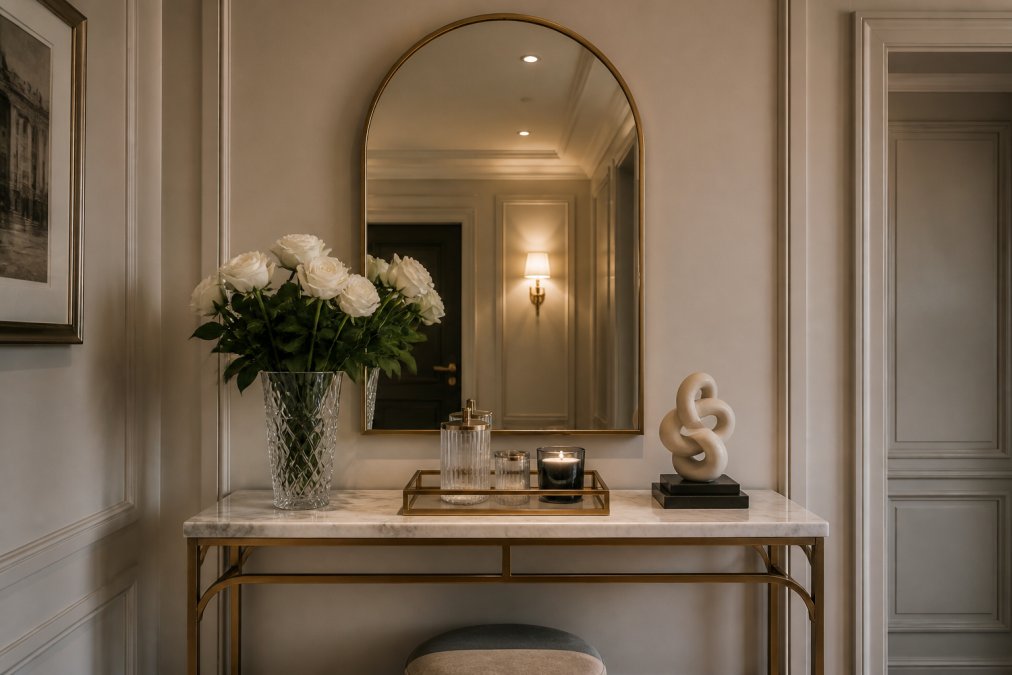
The relationship between mirror and console should feel proportional. The mirror's width should align closely with the console's width, or be slightly narrower to maintain visual breathing room. Styling the console itself requires restraint. In small luxury entryways, three to five carefully chosen objects create more impact than a cluttered surface. A brass-accented decorative object on one side, a sculptural vase on the other, and a single fresh flower arrangement in the centre creates visual rhythm without overwhelming the space.
The frame finish should complement rather than match your console table's material. A brass-framed mirror above a marble console creates visual interest through material contrast. A gilt-framed mirror such as the George II Style Gilt Framed Mirror ($1,495) introduces historical richness and pairs beautifully with contemporary marble or stone consoles.

Lighting transforms a mirror from a reflective object into an active design element. The most effective entryway lighting strategy layers multiple light sources. Wall-mounted sconces flanking the mirror provide direct illumination while creating symmetrical visual balance. Overhead lighting bounces off the mirror's surface and distributes light throughout the entryway. Accent lighting, such as a small table lamp on the console, adds warmth and depth.
Layering means building visual depth through intentional placement of multiple design elements at different distances from the viewer. Start with the mirror as your primary focal point. Position wall-mounted sconces at roughly 150 centimetres from the floor, 30-45 centimetres from the mirror's edge, ensuring light reflects off the mirror and distributes throughout the entryway.
Layer decor elements on the console beneath the mirror. A tall sculptural object on one side creates vertical interest. A lower, wider object on the opposite side creates visual balance through asymmetrical arrangement. A central element, such as a fresh flower arrangement, anchors the composition. This three-point arrangement prevents the console from feeling empty or cluttered.
Warm white light (2700K) creates an inviting, luxurious atmosphere and flatters skin tones. In luxury entryways, warm white lighting is generally preferred because it creates the ambient quality that makes a space feel intentionally designed.
If your entryway receives natural light from a window or glass door, position your mirror to reflect and amplify that light. A mirror positioned opposite a window captures natural light and bounces it deeper into your home, creating the illusion of a brighter, more expansive entry. A mirror angled slightly inward toward the entryway creates a softer, more diffused reflection that distributes light evenly.
Time of day affects how natural light interacts with your mirror. Morning light from the east creates warm, flattering reflections. Afternoon light from the south or west can create harsh shadows. Position your mirror to reflect light upward and across the wall rather than directly toward the entry to prevent glare.
Natural light design principles emphasise that mirrors are among the most effective tools for amplifying daylight in interior spaces, potentially increasing perceived brightness by 30-40%.
Proper mounting is non-negotiable in small entryways where wall space is limited and traffic is constant. For mirrors under 30kg, heavy-duty mirror clips and wall anchors rated for the mirror's weight are typically sufficient. For heavier mirrors, professional installation is advisable.
Wall type determines mounting method. Plasterboard walls require heavy-duty toggle bolts or cavity-fixing anchors. Brick or stone walls accommodate standard masonry anchors. Tile surfaces require diamond-core drill bits and special tile anchors. Identify your wall type before selecting anchors.
Position your mirror at eye level, typically 150 centimetres from the floor, or slightly higher (157-168 centimetres) to create a more flattering reflection and prevent the mirror from dominating the visual space. In small spaces with high foot traffic, maintain at least 30 centimetres of clearance between the mirror's edge and any doorway or pathway to prevent accidents.
Finding authentic luxury mirrors online requires knowing which retailers specialise in genuine designer pieces rather than mass-produced reproductions. Oscar and Mila curates a selection of premium mirrors and entryway decor that emphasises authenticity, craftsmanship, and design integrity.
The difference between luxury mirrors and standard retail options lies in frame construction, glass quality, and design authenticity. Luxury mirrors typically feature solid wood or metal frames rather than veneer. The glass is often bevelled, antiqued, or treated to create depth and visual interest. The Clarendon Round Mirror in Burnt Gold exemplifies this philosophy, it's a statement piece that elevates an entryway's aesthetic while serving its primary function.
When shopping for luxury home decor online, verify authenticity through detailed product descriptions, high-resolution photography, and transparent sourcing information. Oscar and Mila provides comprehensive product documentation that includes dimensions, materials, finish details, and design inspiration.
Not every luxury entryway requires a $1,495 vintage mirror. A strategic DIY approach to mirror framing can create high-end aesthetics at a fraction of retail cost. A basic frameless mirror becomes a design feature when you add a frame using readily available materials. Wooden moulding from hardware retailers can be cut and assembled into a custom frame. Brass or gold-painted moulding creates a luxury aesthetic. The total cost typically ranges from $80 to $200, compared to $800-$1,500 for pre-framed luxury mirrors.
Another budget-conscious approach involves sourcing vintage mirrors from antique dealers or estate sales, then having them professionally re-silvered if the reflective surface has degraded. A vintage mirror with character costs significantly less than a new designer piece, and re-silvering (typically $150-$300) restores full functionality.
Paint and finish techniques can transform an inexpensive mirror frame into a luxury-looking piece. Metallic finishes, gold leaf, copper, or patinated brass create high-end aesthetics. Techniques like dry-brushing or distressing create vintage character at a fraction of professional refinishing costs.
Feng Shui principles offer insights into how mirror placement affects the flow of energy and the psychological experience of moving through a space. In Feng Shui, the entryway is considered the "mouth of chi", the primary point through which energy enters a space. A mirror should expand rather than reflect energy back toward the door, positioning it to reflect the interior of your home rather than the exterior.
A mirror positioned opposite the door creates a sense of expansion and welcome. A mirror positioned to the side of the entry creates flow without visual jarring. The concept of visual balance in Feng Shui aligns with contemporary design principles around symmetrical arrangement and proportional spacing.
Feng Shui also emphasises reflection quality. A mirror with a clear, undistorted reflection is considered more auspicious than one with aged or damaged silvering. This principle has practical merit, a clear mirror reflects light more effectively and creates a more flattering reflection. Frame material carries symbolic significance: metal frames represent clarity and precision, wood represents growth and stability, and stone represents grounding and permanence.
Small luxury entryways demand mirrors that function as both practical reflective surfaces and design statements. The styling choices you make, frame finish, mounting height, lighting combination, and console styling, determine whether your mirror enhances or overwhelms a compact space. At Oscar and Mila, we understand that luxury is about intentional curation. Our mirrors, from the Clarendon Round Mirror to the George II Style Gilt Framed Mirror, are selected for their ability to transform small entryways into sophisticated focal points. Start with a mirror that aligns with your design aesthetic, layer it with appropriate lighting, and style the console beneath it with intentionality. The result is an entryway that feels curated, spacious, and unmistakably luxurious.
A: The ideal height for an entryway mirror is with the centre positioned at approximately 150-160 centimetres from the floor, roughly at eye level. For full-length mirrors, ensure the bottom clears the console table or furniture below by at least 15-20 centimetres. This positioning creates visual balance and prevents the mirror from appearing cramped. Adjust slightly if mounting above a console table; the mirror should sit 10-15 centimetres above the table's surface for proportional spacing.
A: Round and arched mirrors are ideal for small entryways because their soft lines create visual flow without emphasising tight proportions. Octagonal mirrors offer a geometric statement while still feeling refined. Avoid oversized rectangular mirrors in narrow spaces, they can make the area feel more confined. The Clarendon Round Mirror ($895) is a classic choice that adds elegance without overwhelming compact foyers. Round shapes also soften the angular edges of narrow hallways and create a focal point that draws the eye upward.
A: Yes. Mirrors act as reflective surfaces that bounce natural light deeper into the entryway, brightening shadowed areas. Position a mirror opposite or adjacent to a window or light source to maximise this effect. Avoid placing mirrors where they reflect artificial light only, this creates a flat, uninviting look. Polished or bevelled mirrors (like the George II Style Gilt Framed Mirror) reflect light more effectively than frosted finishes. Pair mirror placement with entryway lighting fixtures to amplify both natural and ambient light, creating depth perception and visual warmth.
A: In Feng Shui, mirror placement in entryways requires intentional positioning. Avoid placing a mirror directly facing the front door, as this is believed to reflect energy and opportunity away from the home. Instead, position mirrors on a side wall or above a console table to welcome and circulate positive energy. Mirrors should reflect something beautiful, artwork, plants, or natural light, rather than the entrance itself. This approach aligns Feng Shui principles with modern design, creating an entryway that feels both spiritually balanced and aesthetically curated.
This article was written using GrandRanker
Leave a comment