


Last Updated: August 14, 2026
Selecting the right wall lighting is consequential in high-end residential design. Designer sconces demand more than aesthetic appeal; they require understanding of function, placement, and room-specific demands. The most common mistake is treating sconces as decorative afterthoughts rather than structural lighting elements. Get the selection right early, and everything else benefits.
Ambient lighting is diffused, room-filling illumination that sets mood. Task lighting is directed, higher-intensity light for specific activities like reading or grooming.
Most designer sconces serve one function better than the other. A fabric-shaded sconce suits bedrooms and corridors. A directional swing-arm suits reading nooks or home offices. Confusing the two produces rooms that feel either flat or harsh.
For living rooms and primary bedrooms, ambient sconces at approximately 150-160cm from floor level create the layered, hotel-quality atmosphere high-end clients expect. Bathrooms call for task-oriented fixtures at face height on either side of a mirror, eliminating unflattering shadows.
Hardwired sconces are the standard for luxury residential projects. Plug-in alternatives introduce visible cords and limit placement flexibility in bespoke interiors.
For hardwired installations, the electrical rough-in must be planned before plastering or tiling, which means sconce selection must happen during design development, not at fitout. All electrical work must comply with AS/NZS 3000 (the Wiring Rules) and be carried out by a licensed electrician. The Australian Building Codes Board's guidance on electrical installations outlines the regulatory framework for residential electrical work.
Lock in sconce specifications before the rough-in. Changing placement after walls are closed is expensive and disruptive.
The difference between good lighting and exceptional lighting comes down to layering. A single light source, however beautiful, produces flat rooms. Luxury lighting design combines multiple light types, each doing a specific job.
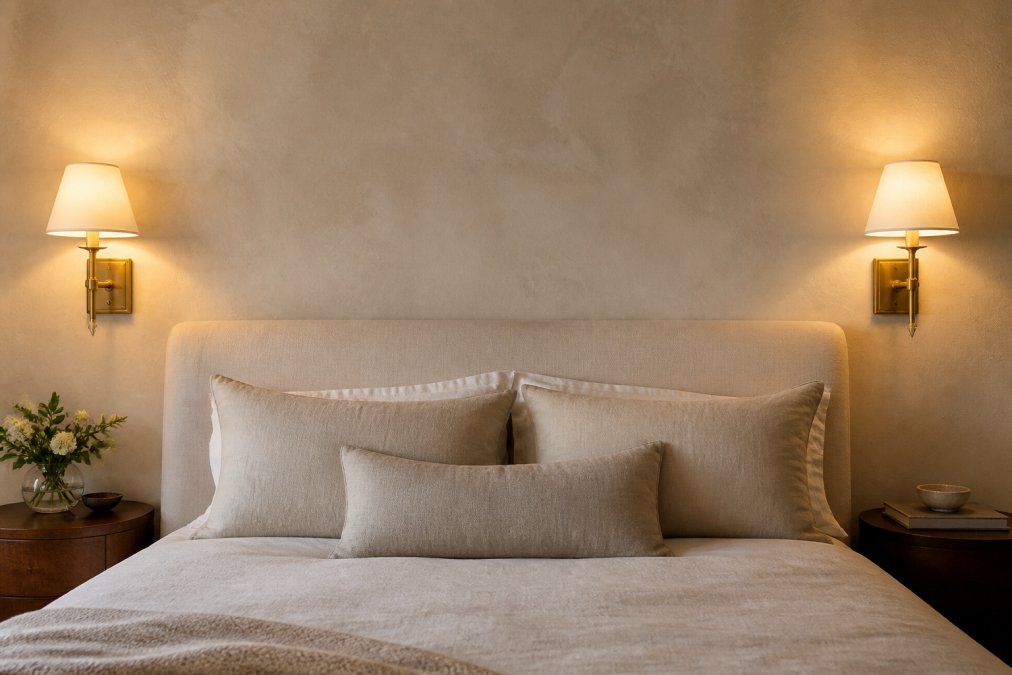
Three layers form the foundation of any professional lighting plan:
The most sophisticated residential interiors use all three simultaneously, with dimmable controls on each circuit so balance shifts with time of day or occasion. According to the Illuminating Engineering Society's residential lighting guidelines, layered lighting schemes consistently produce higher occupant satisfaction than single-source approaches.
Colour temperature is measured in Kelvin (K). For luxury residential interiors, the accepted range is 2700K-3000K, called warm white. This range flatters skin tones, enhances timber and stone, and creates warmth defining refined interiors.
Cooler temperatures (4000K and above) read as clinical in home environments. Avoid them in living rooms, bedrooms, and dining spaces.
Dimmable lighting is essential in luxury briefs. Every sconce circuit should connect to a compatible dimmer, requiring LED-compatible dimmers and confirmation that chosen fixtures support dimming before procurement.
The gap between well-made sconces and poorly manufactured ones becomes apparent within two to three years: finishes oxidise unevenly, shades yellow, and hardware loosens. For architects and designers specifying on behalf of clients, brand provenance matters.
Visual Comfort is the benchmark for high-quality craftsmanship in designer sconces. The brand commissions collections from named designers, Thomas O'Brien, Kelly Wearstler, E. F. Chapman, Julie Neill, J. Randall Powers, each bringing distinct aesthetic vocabulary. Visual Comfort fixtures are designed with installation in mind: backplate dimensions are standardised across collections, finishes are applied consistently, and socket specifications are clearly documented. For specifiers managing multiple fixtures across large projects, this consistency reduces procurement errors significantly.
Oscar and Mila carries the full Visual Comfort Signature collection, offering trade professionals access to these fixtures with curated boutique support.
The ten fixtures below represent the strongest options currently available for luxury residential specifications, all drawn from the Visual Comfort Signature collection.
Quick Picks:
The Piaf is the most elegant entry point. Thomas O'Brien's softly curved arm and delicate detailing make it read as considered rather than decorative. The linen shade diffuses light warmly, ideal for corridors, bedrooms, and sitting rooms.
Specifications: H 47.6cm, W 16.5cm, E14 socket, 12.1cm round backplate.
Best for: Hallways, guest bedrooms, minimalist aesthetics.
View the Piaf Single Wall Sconce
The Bryant with linen shade is one of the most versatile designer sconces. Available in brass, bronze, bronze and brass, antique nickel, and polished nickel, it adapts to many palettes without losing identity. The metal-and-linen combination is signature Thomas O'Brien: traditional proportion, contemporary restraint.
Specifications: H 36.9cm, W 14cm, Extension 22.3cm, E27 socket.
Best for: Primary bedrooms, hallways, living rooms with classic aesthetic.
View the Bryant Wall Sconce (Linen)

The Dauphine delivers minimalist silhouette with enough detail to hold interest. The linen shade pairs with gilded iron base for warm ambience, and the square backplate (10.2cm) suits tight wall spaces.
Specifications: H 48.3cm, W 14cm, Extension 11.4cm, E14 socket.
Best for: Powder rooms, narrow corridors, minimalist interiors.
The Hackney is built around a coolie linen shade referencing mid-century American design without feeling nostalgic. J. Randall Powers keeps the base simple, letting the shade work. The wider width (22.9cm) casts a broader pool of ambient light.
Specifications: H 35.6cm, W 22.9cm, Extension 23.5cm, E14 socket.
Best for: Living rooms, reading corners, spaces where ambient spread matters.
View the Hackney Single Sconce
The glass shade variant shifts the fixture's character considerably. Where linen is warm and diffused, white glass produces cleaner, more contemporary result. Same proportions and quality, different mood. This is the Bryant for cooler palettes or modern aesthetics.
Specifications: H 36.9cm, W 14cm, Extension 22.3cm, E27 socket.
Best for: Contemporary kitchens, modern bathrooms, cool-palette interiors.
View the Bryant Wall Sconce (Glass Shade)

The Elkins occupies the same design language as the Bryant with slightly more compact profile (H 32.4cm). The 14cm round backplate and E14 socket suit spaces needing smaller footprint without sacrificing quality. Available in bronze and brass, it works well with warm timber joinery.
Specifications: H 32.4cm, W 14cm, Extension 17.8cm, E14 socket.
Best for: Bedside placement in lower-ceiling rooms, studies, dressing rooms.
Crystal and fabric rarely combine this successfully. Julie Neill's Lucia uses crystal detailing to catch and refract light, producing warm, even glow. The elongated form (H 52.7cm) reads as sculptural, making it statement lighting that functions beautifully as ambient illumination.
Specifications: H 52.7cm, W 14cm, Extension 15.2cm, E14 socket.
Best for: Primary bedrooms, formal living rooms, dining rooms with statement lighting brief.
View the Lucia Medium Tail Wall Sconce

The Gramercy is the most classical fixture on this list. E. F. Chapman's gilded iron finish and detailed silhouette reference Georgian and Federal period lighting without reproducing it literally. The double-arm configuration (two E14 sockets) provides more light output, suiting larger walls and double-height spaces.
Specifications: H 40.1cm, W 31.8cm, Extension 19.7cm, 2 x E14 sockets.
Best for: Formal entrance halls, libraries, architectural walls requiring traditional-meets-contemporary fixtures.
View the Gramercy Double Sconce
The Cleo is architectural in the truest sense. Kelly Wearstler's combination of geometric forms, bronze, and antique burnished brass creates wall sculpture. The contrast between organic curves and precise metalwork gives character that reads differently depending on surrounding palette.
Specifications: H 35.6cm, W 17.8cm, Extension 20.3cm, E27 socket.
Best for: Feature walls, master bathrooms, contemporary interiors where decorative lighting carries visual weight.
The Melange is the most collectible piece on this list. Natural alabaster carved into elongated forms, contrasted with bronze or burnished antique brass, each piece varies in veining and tone. The dedicated LED socket and slim profile (W 10.8cm, Extension 8.9cm) suit narrow architectural walls.
The variation is the point. Clients expecting uniformity will be disappointed; those understanding variation as collectible value will treasure it.
Specifications: H 50.8cm, W 10.8cm, Extension 8.9cm, dedicated LED socket.
Best for: Master suites, bespoke interiors, projects requiring genuinely one-of-a-kind pieces.
View the Melange Elongated Wall Sconce
| Sconce | Price | Socket | Height | Best For |
|---|---|---|---|---|
| Piaf Single | $495 | E14 | 47.6cm | Corridors, guest bedrooms |
| Bryant (Linen) | $525 | E27 | 36.9cm | Bedrooms, hallways |
| Dauphine | $535 | E14 | 48.3cm | Powder rooms, narrow corridors |
| Hackney Single | $615 | E14 | 35.6cm | Living rooms, reading corners |
| Bryant (Glass) | $655 | E27 | 36.9cm | Contemporary kitchens, bathrooms |
| Elkins | $810 | E14 | 32.4cm | Compact bedrooms, dressing rooms |
| Lucia Tail | $855 | E14 | 52.7cm | Formal living, dining rooms |
| Gramercy Double | $925 | 2 x E14 | 40.1cm | Entrance halls, libraries |
| Cleo | $1,125 | E27 | 35.6cm | Feature walls, master bathrooms |
| Melange Elongated | $1,825 | Dedicated LED | 50.8cm | Bespoke interiors, master suites |
Correct sconce spacing is where many otherwise well-designed rooms fall apart. Consistency and proportion matter more than any single measurement.
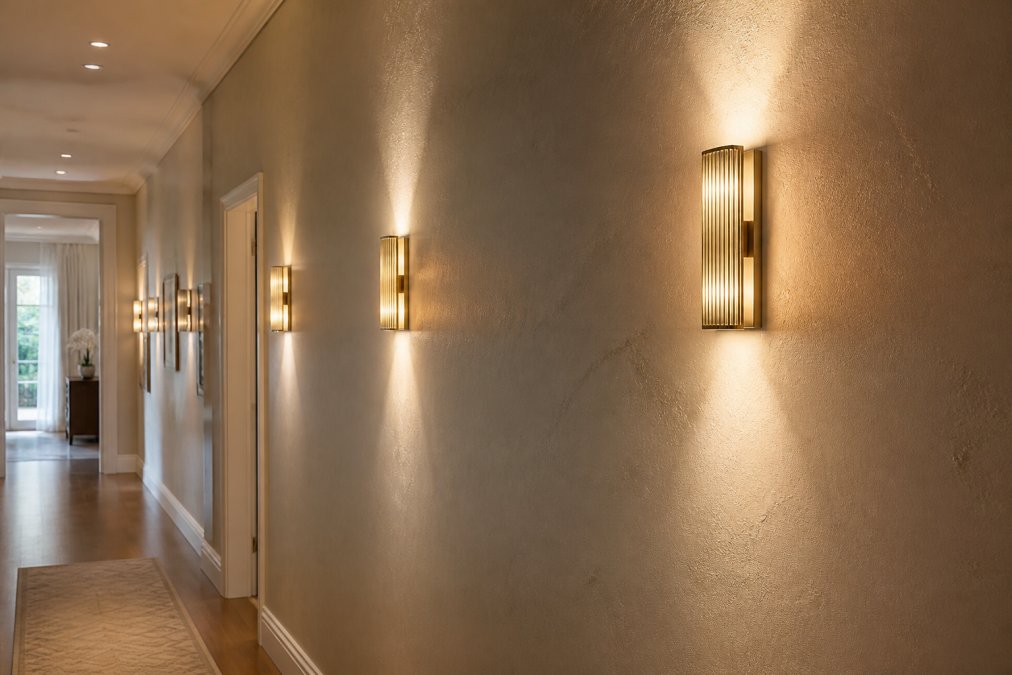
Bedside sconces should be mounted so the centre of the shade sits at approximately 150cm from finished floor level. This positions light at reading height when sitting up in bed, without glare when lying down.
For standard queen or king beds, sconces should centre above each bedside table, typically 70-80cm from the bed's centreline on each side. Maintain minimum 20cm clearance from the headboard to prevent knocking and allow visual appreciation.
For hallways, spacing of 180-240cm between sconces produces even rhythm without repetition. Exact interval depends on ceiling height and wall length; longer walls with higher ceilings accommodate wider spacing. Goal is overlapping pools of warm light creating continuous illumination rather than isolated spots.
On architectural feature walls in living rooms, treat sconces as part of wall composition. Align to horizontal midline of artwork or joinery. Symmetry is default; asymmetric placement requires strong compositional reason.
According to the Australian Interior Design Association's guidelines on residential lighting, fixture placement should be resolved on architectural drawings before electrical rough-in.
Hardwired wall sconce installation involves three phases: rough-in, fixture mounting, and final connection.
Rough-in: The electrical box must position precisely at intended mounting height before walls close. Standard residential boxes suit most sconces, but larger backplates may require purpose-built bracket or additional wall blocking.
Fixture mounting: Visual Comfort sconces use standardised backplate system connecting to electrical box via mounting strap. Backplate dimensions determine whether standard box works or extension ring is needed.
Final connection: All connections must be made by licensed electrician per AS/NZS 3000. The Energy Safe Victoria guidance on electrical safety in residential buildings provides reference for compliance obligations.
Globe specification is separate. Most Visual Comfort sconces sell without globes; socket type determines compatibility. E27 sockets accept standard screw-base globes; E14 requires candelabra base. The Melange Elongated has integrated LED driver requiring no globe selection.
LED globes for E14 and E27 sockets are standard for new installations. They produce equivalent lumen output at fraction of incandescent energy draw, with colour rendering index (CRI) now typically 90 or above, ensuring accurate material, finish, and skin tone rendering.
Dimmable LED systems paired with compatible dimmers reduce energy consumption further and extend globe life. For multi-sconce installations across large residences, cumulative energy saving is meaningful.
The Australian Government's Your Home technical manual on lighting provides guidance on selecting energy-efficient lighting systems, including globe, dimmer, and control interactions.
For specifiers working to green star or NatHERS benchmarks, lighting power density calculations include all fixed wall-mounted fixtures. Lower-wattage LED globes for sconces can contribute meaningfully to overall energy performance ratings.
The right choice depends on room function, aesthetic brief, and budget.
For bedrooms and corridors prioritising ambient warmth, the Thomas O'Brien Bryant (linen) and Piaf Single represent strongest options, delivering classic proportions and diffused light quality defining residential comfort.
For living rooms and formal spaces where fixtures carry visual weight, the Gramercy Double and Lucia Tail offer scale and material quality for large rooms.
For clients wanting genuinely collectible pieces, the Kelly Wearstler Cleo and Melange Elongated are clear choices. Both are architectural, material in luxury, and distinctive enough to define rooms.
Start with the room, wall, and function. The right fixture follows from that.
Wall sconces remain one of the most enduring fixtures in high-end residential interiors. Unlike overhead lighting, designer sconces create layered illumination that adds depth and warmth to a room. Architectural lighting designers continue to specify wall-mounted lamps as a primary tool for achieving spatial richness, particularly in bedrooms, hallways and living rooms where ambient lighting sets the tone. The range of finishes, from aged brass to sculptural alabaster, means they adapt to both contemporary and classical schemes.
Premium designer sconces are distinguished by the quality of their materials and the precision of their construction. Brass finishes, whether antique, gilded or polished, remain a benchmark for high-quality craftsmanship. Natural materials such as linen shades, crystal detailing and carved alabaster (as seen in the Kelly Wearstler Melange series) add tactile and visual richness. The hardware, backplates and arm profiles on luxury fixtures are machined to tighter tolerances than mass-market alternatives, which shows clearly in the finished installation.
Start with the room's lighting function: a bedside sconce needs directional, dimmable task lighting, while a hallway or living room calls for ambient or accent lighting. Then match the fixture's scale to the wall and ceiling height. A 35-50cm sconce suits standard residential wall heights of 2.4-2.7m. Finally, align the finish and silhouette with the broader interior palette. Minimalist spaces suit clean geometric forms; more ornate schemes carry sculptural or crystal-detailed pieces. Confirming the socket type (E14 or E27) and whether the fitting is hardwired early avoids costly changes on site.
The standard mounting height for wall sconces in residential interiors is 150-170cm from the finished floor to the centre of the backplate. In bedrooms, position bedside sconces so the bottom of the shade sits at roughly shoulder height when seated in bed, typically 120-140cm from the floor. For hallways, space sconces 150-200cm apart to create even pools of light without dark gaps. Always plan sconce placement on the electrical rough-in drawings before plastering to avoid surface-mounted conduit runs in a finished luxury interior.
Natural stone shades, particularly alabaster, are among the most sought-after materials in bespoke lighting right now, valued for their unique veining and the warm glow they cast. Elongated vertical silhouettes are gaining ground over traditional arm-and-shade forms, suiting the taller wall panels common in new luxury builds. Warm white colour temperatures (2700-3000K) with full dimming capability remain the specification standard. Brass finishes continue to dominate, though burnished and antiqued variants are preferred over bright polished brass for a more refined, timeless result.
Selecting designer sconces for luxury residential projects is a decision that rewards careful specification and punishes shortcuts. Oscar and Mila's curated Visual Comfort Signature collection gives architects, interior designers, and discerning homeowners access to fixtures that combine high-quality craftsmanship with genuine design provenance. Browse the full collection at Oscar and Mila to find the sconce that belongs in your project.
This article was written using GrandRanker
Leave a comment