


Last Updated: September 16, 2026
Architectural lighting design is the discipline of planning how light interacts with a built space, treating fixtures as structural elements rather than afterthoughts. It balances ambient, task, and accent layers so a room functions well and feels intentional.
That definition matters more than most buyers realise. When you're choosing unique high end lighting fixtures, you're not shopping for a lamp. You're commissioning the element that decides how every surface, texture, and finish in the room reads after dark.
This guide breaks down the selection criteria that separate a considered scheme from an expensive mistake: scale, materials, colour temperature, installation, and the specific requirements of bespoke pieces.
Lighting is also the one design decision you cannot easily reverse. Paint is a weekend. A 153cm linear pendant hung from a 45.7cm minimum drop is a structural commitment.

The most reliable approach to layering is the three-tier method: ambient light for general illumination, task lighting for specific activities, and accent lighting for depth and drama. Every high end lighting scheme uses all three, and the ratio between them is what creates atmosphere.
Ambient lighting does the heavy lifting. A sculptural pendant or a pair of discreet ceiling fixtures provides the base layer, usually dimmable, usually warm.
Task lighting sits where work happens: a kitchen island, a reading chair, a vanity. Sconces and adjustable pendants handle this well.
Accent lighting is where sophistication lives. Uplighting a wall, grazing a textured surface, or highlighting art with a narrow beam adds visual weight and a focal point that flat overhead light destroys.
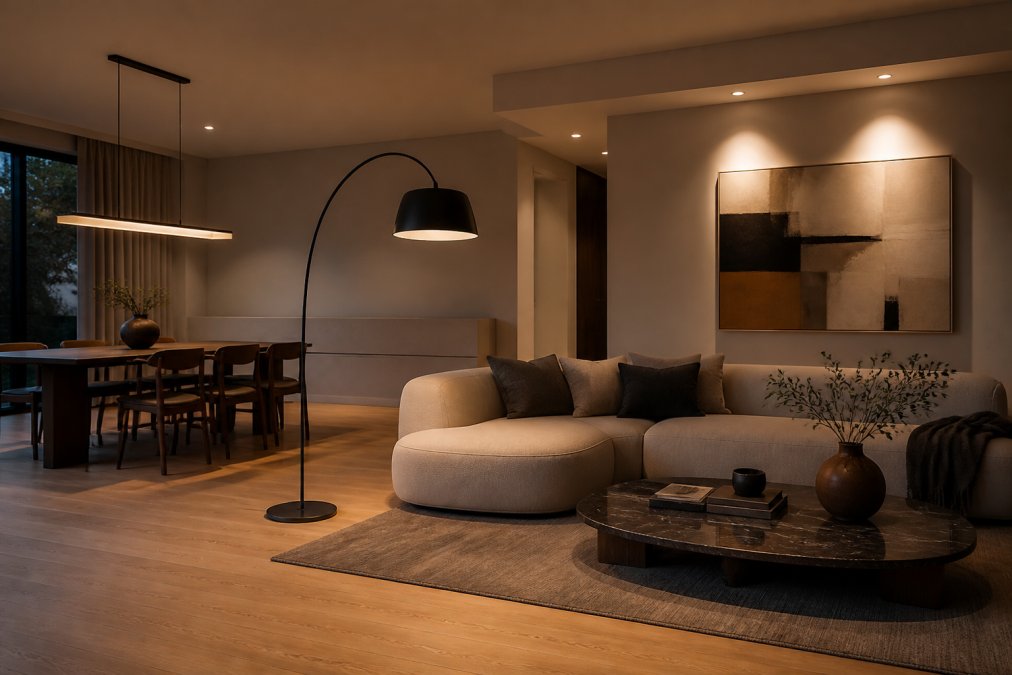
What separates a genuine designer lighting brand from a lookalike comes down to three things: the integrity of the materials, the precision of the finish, and whether the piece is engineered to be installed, not just photographed. Brass that is solid rather than plated. Glass that is hand-finished rather than moulded. Canopies designed to sit flush against a real ceiling.
The distinction shows up in the specification sheet. A bespoke pendant lists its canopy dimensions, socket type, and minimum custom height because the manufacturer expects an electrician to read it. A knockoff lists a picture.
When comparing houses, work through these in order:
This is the angle most buying guides skip: high end lighting is one of the few interior purchases that behaves like an asset rather than a consumable. A documented, named-designer fixture from an established house can be removed and re-hung in a future property. A generic lookalike has no resale market at all.
Three practical implications for buyers:
Oscar and Mila curates pieces from houses such as Visual Comfort and Ralph Lauren, which means the collection is filtered rather than exhaustive. For buyers who have been burned by online "luxury" that arrived as a cheap imitation, that curation is the point: every piece in the range is traceable to a named designer and a documented specification.
Visual Comfort Kelly Wearstler Utopia →
Australian Competition and Consumer Commission guidance on consumer guarantees for major purchases Australian Competition and Consumer Commission guidance on consumer guarantees for major purchases
Fixture scale is the most frequent error in high end lighting, and it runs in both directions. A pendant that looks generous in a showroom can overwhelm a dining table; a chandelier sized for a stairwell will disappear over a kitchen island.
Work from the room's proportions, not the fixture's. As a working rule, a pendant or chandelier should span roughly one-third to one-half the width of the table or island beneath it, and its lowest point should clear the surface by at least 75cm for dining and 90cm for a kitchen bench.
| Space | Fixture width guide | Minimum clearance | Best fixture type |
|---|---|---|---|
| Dining table | 1/3 to 1/2 table width | 75cm above surface | Linear pendant, chandelier |
| Kitchen island | 1/3 to 1/2 island width | 90cm above bench | Linear pendant, pair of pendants |
| Entry or stairwell | Proportionate to void width | 210cm above floor | Sculptural pendant |
| Bedside or hallway | 20-30cm diameter | 60cm above surface | Sconce, small pendant |
Ceiling height changes the calculation.
Materials decide whether a fixture ages into a patina or into a problem. The finishes that hold their value are the honest ones: aged iron, solid brass, hand-finished glass, natural stone.
Most guides stop at "choose quality materials." The more useful question is which material palette belongs in which architecture. Get this wrong and even an expensive fixture looks borrowed.
| Architectural style | Material palette that works | Material to avoid |
|---|---|---|
| Mid-Century Modern | Walnut-toned brass, opal glass, blackened steel | Ornate crystal, heavy gilding |
| Industrial / warehouse conversion | Aged iron, exposed filament globes, raw brass | Polished chrome, delicate porcelain |
| Contemporary minimal | Matte black, brushed nickel, alabaster, frosted glass | Busy crystal, multi-arm chandeliers |
| Heritage / period | Antique brass, hand-cut crystal, bronze, silk shades | Matte black, exposed LED strips |
| Coastal / relaxed | Weathered brass, rattan or woven shades, seagrass | High-polish chrome, heavy stone |
High end does not mean low maintenance, and the trade-offs are worth knowing before purchase:
Bespoke and oversized fixtures demand planning before purchase, not after delivery. The technical requirements that competitors gloss over are exactly where projects stall.
Three things need confirming before you order:
A general guideline suggests hanging pendants so the bottom sits approximately 170 cm from the floor. This height works for most spaces, but adjust based on ceiling height and fixture size. For a dining table, aim for 75-85 cm above the tabletop. Always check the fixture's specifications for minimum height requirements.
High end lighting often features solid brass, bronze, alabaster, and hand-blown glass. These materials offer durability and a refined look. For example, the Kelly Wearstler Melange Floating Disc Chandelier pairs natural alabaster with sleek metal, while the Utopia Linear Pendant uses carved bronze and glass. Such materials ensure each piece ages gracefully and remains a focal point.
Add the room's length and width in metres, then convert to centimetres for the ideal chandelier diameter. For a 5m x 4m room, a 90cm wide fixture works well. Also consider ceiling height: taller ceilings can handle larger pieces. For open spaces, a linear pendant like the Utopia Large Linear Pendant (153cm wide) can define zones without overwhelming.
Sculptural forms, mixed metals, and natural materials like alabaster are prominent. Layered lighting with dimmable LEDs allows for mood setting. Bespoke fixtures tailored to architectural details are also in demand. Brands like Visual Comfort offer pieces that blend art and function, such as the Cleo Pendant with its geometric metalwork.
Leave a comment