


Last Updated: September 24, 2026
The grid of ceiling holes that defined residential lighting for thirty years is losing its grip. Homeowners are actively searching for alternatives to standard recessed lighting for homes because the can light look reads as dated, and the practical case against it keeps growing.
Recessed downlights were built for one job: washing a room in even, flat light. Designers now push back, a ceiling full of cans flattens architecture, erases depth-giving shadows, and offers no focal point.
There are practical frustrations too. Retrofitting old housings means matching can sizes, checking voltage compatibility, and often discovering the existing dimmer won't drive new LED drivers. Add ceiling penetrations that compromise insulation and the case for change becomes obvious.
At Oscar and Mila, we see this shift in what clients ask for: fewer holes in the ceiling, more sculptural pieces that earn their place. This guide covers architectural principles, layered techniques, non-recessed fixtures, and how to remove old cans cleanly.
Architectural lighting design plans light around how a room is built and used, rather than filling it with evenly spaced fixtures. Where a downlight grid optimises for coverage, architectural lighting optimises for intention, every fixture has a stated job, a target surface, and a reason for being where it is.
The guiding rule is simple: light the surfaces, not the floor. A wall lit at 45 degrees reads as taller; a wall left dark above a sofa collapses the room's perceived height.
Most practitioners work from four variables rather than a fixture catalogue. Get these right and the fixture choice becomes obvious.
Beam angle. A narrow beam (15-24 degrees) throws a tight pool of light and suits accenting a single object. A medium beam (36-40 degrees) is the workhorse for wall washing and task light. A wide beam (60 degrees plus) floods and suits utility spaces. Standard recessed cans ship with a fixed 60-90 degree beam, which is why they wash everything and highlight nothing.
Mounting height and spacing ratio. For wall washing, space wall-washers at roughly their distance from the wall, so a fixture 600mm off the wall sits 600mm from its neighbour. For ambient from a pendant, the shade bottom typically sits 2.1-2.4 metres above the floor in a standard 2.7 metre room, or 750-850mm above a dining table.
Layered brightness ratio. A workable target is ambient at roughly 50 per cent of total light output, task at 30 per cent, and accent at 20 per cent. If ambient exceeds about 60 per cent, the task and accent layers visually disappear, the most common failure in a converted room.
Colour temperature consistency. Mixing 2700K and 4000K in one sightline reads as a mistake, not a choice.
Layering replaces the grid with three distinct jobs: ambient light for general illumination, task lighting for focused work, and accent lighting for drama.
Homeowners often start by shopping for a pendant, then build a scheme around it. The stronger sequence is the reverse: decide the layers, decide the ratios, then choose fixtures that fit the brief. A beautiful pendant in an over-lit room reads as clutter; a modest pendant in a correctly layered room reads as the centrepiece it was meant to be.
Layered lighting techniques for living rooms combine three light sources at different heights and intensities so no single fixture carries the whole room. The result is flexibility: bright for entertaining, soft for evenings.
For a typical living room, the practical split looks like this:
| Layer | Job | Typical Fixture | Placement |
|---|---|---|---|
| Ambient | General illumination | Chandelier, pendant, floor lamp | Ceiling centre or corner |
| Task | Reading, working | Swing arm sconce, floor lamp | Beside seating |
| Accent | Drama, highlighting | Wall sconce, picture light | On walls, above art |
Wall sconces vs downlights is not a fair fight once you understand what each does well. Downlights deliver even, downward illumination. Sconces deliver vertical light that grazes walls, adds warmth, and creates the shadow play that makes a room feel designed.
Sconces win in hallways, beside mirrors, flanking beds, and along stairwells. They add architectural interest at eye level, where downlights leave walls blank. The Thomas O'Brien Kairos 14" Double Sconce, with its aged iron and Roman bronze finish and linen shades, does ambient and accent work simultaneously.

Non-recessed lighting replaces ceiling holes with surface-mounted and suspended fixtures that become part of the room's design rather than disappearing into it. This is where the biggest aesthetic gains happen.
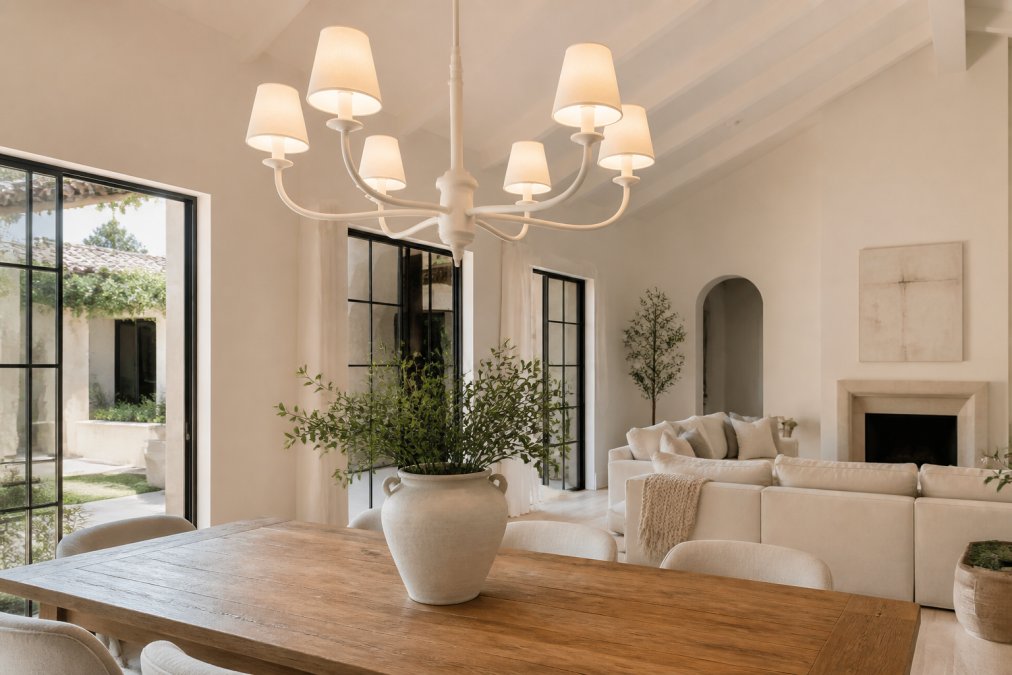
Pendants and chandeliers turn the ceiling into a feature instead of a grid. They define zones, anchor furniture, and give a room a centre of gravity that downlights never provide.
Not every room can take a ceiling fixture, and not every ceiling should. Floor lamps and swing arm sconces deliver layered light without touching the ceiling at all.
Ceiling aesthetics in 2026 favour restraint and intentionality. The trend is fewer fixtures, each chosen for presence rather than coverage. Sculptural forms, plaster and natural finishes, and warm metals are replacing the anonymous white trim ring.
Translated into practical terms, the 2026 direction means three concrete things about your ceiling.
Here is the gap most guides leave open. Switching from a downlight grid to a statement ceiling fixture is not just a shopping decision, it is a ceiling repair project, and the finished ceiling's aesthetics depend on how well it is done.
The sequence, in practice:
Once the ceiling is patched and repainted, the fixture you hang has to justify the work. The test is simple: does it hold the room on its own, with the supporting layers doing their jobs quietly around it?
Removing recessed lights is a straightforward job for a licensed electrician, and patching the ceiling afterwards is standard plastering work. Most homeowners should not attempt the electrical side themselves.
Pendants, chandeliers, wall sconces, floor lamps and swing arm sconces all replace the flat ceiling look with something more sculptural. A pendant or chandelier handles ambient light in a dining room or entry, sconces wash walls and add depth, and floor lamps cover reading corners without any ceiling work. Most homes combine two or three of these rather than relying on one type.
You have two paths. The first is to leave the housings in place and swap the trim or fit a retrofit LED conversion kit, which keeps the ceiling intact. The second is to remove the fixtures entirely, then patch the openings with plasterboard offcuts, tape and joint compound, and sand flush before repainting the whole ceiling. Patching a handful of holes is a job most plasterers complete in a day.
Ambient lighting fills a room with an even, soft glow, usually from a chandelier, pendant or uplight. Task lighting is directed at a specific activity, such as a swing arm sconce beside a bed or a floor lamp over a reading chair. Layered lighting techniques for living rooms combine both, plus accent lighting on art or architecture, so no single source has to do all the work.
Sconces and downlights solve different problems. Sconces throw light up and down a wall, which adds warmth and makes a room feel taller, and they suit hallways, bedrooms and mirror surrounds. Downlights deliver concentrated pools of light for kitchens and task zones. The benefits of wall sconces vs downlights come down to mood versus function, and most well-lit homes use both.
A uniform grid of small downlights across a whole ceiling is the look most designers now steer away from, because it flattens a room and leaves no focal point. Cool white bulbs above 4000K also date quickly in residential settings. Instead, anchor the ceiling with one sculptural piece and build the rest of the scheme from sconces, lamps and accent lighting.
Leave a comment