


Last Updated: September 23, 2026
Heirloom quality furniture is built to survive generations, not decades. The difference comes down to three things: solid timber construction, traditional joinery, and hand-finished details machines cannot replicate.
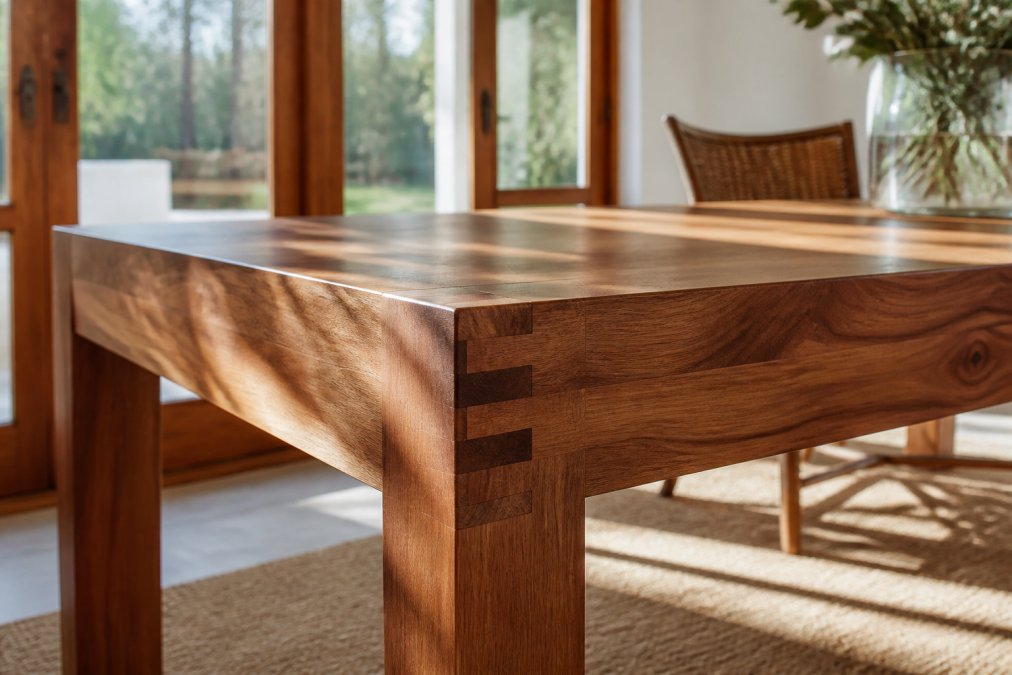
Most guides tell you to 'look for dovetails'. That is true but incomplete. A better approach is to inspect in a fixed sequence, from the joints outward, judging each element by whether it can be repaired in 20 years.
Joints are the clearest signal of intent.
Run a finger along the inside of a drawer. A hand-cut dovetail feels slightly irregular; a machine-cut one is uniform but tight. A stapled drawer box has visible metal and a thin base.
Look at the end grain of a tabletop or the underside of a chair seat. A thin layer of timber over a different core means veneer, not automatically bad over a stable substrate, but it changes how the piece can be repaired. Check for quarter-sawn grain on tabletops: straight, parallel lines rather than wide cathedral arches, since quarter-sawn tops are more stable and less likely to cup.
Finish determines repairability. Natural oil and wax finishes can be spot-repaired, hardwax oils blended; lacquers and two-pack polyurethanes are harder to repair invisibly. Ask the maker what finish is used and how a scratch or water mark would be fixed.
Open and close every drawer and door; they should run smoothly without binding. Dovetailed drawers on wooden runners can be waxed and adjusted; metal runners are a replaceable wear item. Rock a chair gently: a frame that flexes at the joints will loosen, while a rigid frame is likely dowelled or mortise-and-tenon jointed.
This is the question most buyers never ask, and it separates genuine heirloom furniture from furniture that merely looks traditional.
| What to check | Heirloom signal | Mass-production signal |
|---|---|---|
| Drawer joints | Hand-cut dovetails | Staples, thin base |
| Frame joints | Mortise and tenon, dowelled | Screws and glue only |
| Tabletop | Solid or quarter-sawn | Thin veneer over particleboard |
| Finish | Oil, wax, repairable lacquer | Two-pack, non-repairable |
| Repairability | Disassembles, parts available | Glued shut, no spares |
Australian Furniture Association, industry standards and maker directories
Solid hardwood is the foundation of any piece worth inheriting, but 'hardwood' is not a single specification. Species, drying, cutting and finishing determine whether a piece tightens up over decades or slowly fails.
Most buying guides stop at 'choose hardwood'. The useful question is how a species behaves across 20 to 50 years of humidity swings, heating and direct sun.
Two tables can be built from the same species and age very differently. The deciding variables are:
A hardwood frame is only half the story. Traditional upholstery uses webbing, hessian, horsehair or high-density foam, and hand-tied springs. These can be re-tensioned and replaced. Foam-only construction with a stapled frame can be reupholstered once, but the frame often fails before the fabric does. Look for frames that are glued and screwed or dowelled at the corners, not stapled, and ask whether the legs are part of the frame or attached separately.
Finish choice determines whether a scratch is a five-minute fix or a full refinish.
| Material | Durability | Repairability | Typical best use |
|---|---|---|---|
| Solid Jarrah | Very high | Excellent | Dining tables, structural frames |
| Solid Blackwood | High | Excellent | Cabinetry, decorative pieces |
| Solid Spotted gum | Very high | Very good | Tabletops, heavy-use surfaces |
| Tasmanian oak | Moderate to high | Very good | Bedroom furniture, painted pieces |
| Imported oak or walnut | High (if acclimatised) | Very good | Feature pieces, veneered panels |
| Powder-coated aluminium | High | Moderate | Outdoor frames |
| Particleboard with veneer | Low | None | Budget flat-pack only |
Responsible Wood, Australian standard for sustainable forest certification
The best heirloom quality furniture brands combine artisan-made construction with materials that improve with age. Each maker below earns a place through verifiable craftsmanship, not marketing.
1. Oscar and Mila
2. Artisan timber workshops
3. Heritage reproduction specialists
4. Sustainable forestry furniture makers
5. Custom upholstery houses
6. Local craftsmanship studios
7. Designer homewares curators
8. Bespoke commission specialists
9. Restoration and repair services
10. Second-hand and vintage dealers
Custom-made pieces offer the best long-term value for buyers who can wait. Ready-to-ship options suit those furnishing a space immediately.
| Option | Lead Time | Price Range | Best For |
|---|---|---|---|
| Custom commission | 12-20 weeks | Highest | Unique spaces, specific dimensions |
| Pre-order artisan pieces | 8-16 weeks | High | Rare designs, authenticated provenance |
| Ready-to-ship | Immediate | Varies | Immediate furnishing needs |
| Restored vintage | Immediate | Moderate | Character pieces, sustainability |
Oscar and Mila offers a curated selection of designer furniture, lighting, and home decor for both interior and exterior spaces. The collection includes pieces from premium brands like Visual Comfort and Ralph Lauren, alongside artisan mirror collections from Florence.
Heirloom quality furniture is built to last generations, using solid timber, traditional joinery techniques like dovetail joints and mortise and tenon, and hand-finished details. It often features sustainable materials and ethical production methods. Such pieces are designed to withstand daily use and retain their value over time, becoming family treasures.
Australia has a range of high-end furniture brands, including Oscar and Mila, which offers curated designer pieces from premium international names like Roberto Giovannini. Other notable brands focus on local craftsmanship and sustainable practices. When evaluating brands, look for transparency about materials, construction methods, and warranty terms to ensure quality.
Examine the joinery: look for dovetail joints and mortise and tenon rather than screws or staples. Check for solid timber, not particle board or veneers. Feel the finish for smoothness and consistency. Look for hand-carved details and signs of hand-finishing. Ask about the origin of materials and the manufacturing process. A reputable brand will provide detailed information.
Seek solid hardwoods like teak, oak, or mahogany, known for durability. Sustainable forestry certifications ensure eco-friendly sourcing. Natural finishes, such as oil or wax, protect the wood without harsh chemicals. For upholstery, choose high-quality fabrics and dense foam. Materials like Brazilian teak, used in Oscar and Mila's Normandy dining table, offer weather resistance and longevity.
Custom-made furniture can be better for heirloom quality because it allows you to specify materials, dimensions, and finishes that suit your space and style. It often involves working directly with artisans, ensuring attention to detail. However, ready-to-ship pieces from reputable brands can also be heirloom quality if they meet construction and material standards.
Furnishing a home with pieces that last generations requires more than a large budget. It requires knowing what to look for and where to find makers who still build things properly. Oscar and Mila curates designer furniture, lighting, and mirrors from artisan workshops with documented heritage, including the Roberto Giovannini collection produced in Florence since 1958. Browse the collection to find pieces worth passing down.
Leave a comment