


Last Updated: September 25, 2026
Designer mirrors are decorative, high-quality mirrors chosen for their craftsmanship, materials, and ability to act as a focal point rather than a purely practical fixture. This guide from Oscar and Mila shows you how to place them well, from room to room, and how to keep them looking sharp once they are up.
Mirrors shape light and space in ways no other wall piece can. They bounce natural light into dark corners and create spatial depth where a room has none. That is why designers treat a mirror as a statement piece, not a finishing touch.
Three effects do the heavy lifting:
Luxury wall mirror placement tips come down to one rule: put the mirror where it reflects something worth seeing. A mirror facing a blank wall does nothing. A mirror facing a window, a garden view, or a styled corner earns its place.
The entryway sets the tone, so this is where a bold mirror pays off. Hang it opposite the front door or above a console table. It catches light from the doorway and gives you a final check before you leave.
Open-plan rooms need help defining zones. A large mirror on a side wall can mark the living zone without adding a physical divider. Avoid placing a mirror directly opposite a television, where glare becomes a nightly annoyance.
Styling oversized mirrors in living rooms is about proportion and restraint. A mirror that is too small for the wall looks like an afterthought. One that is too large overwhelms everything around it. The difference between the two is usually maths, not taste.
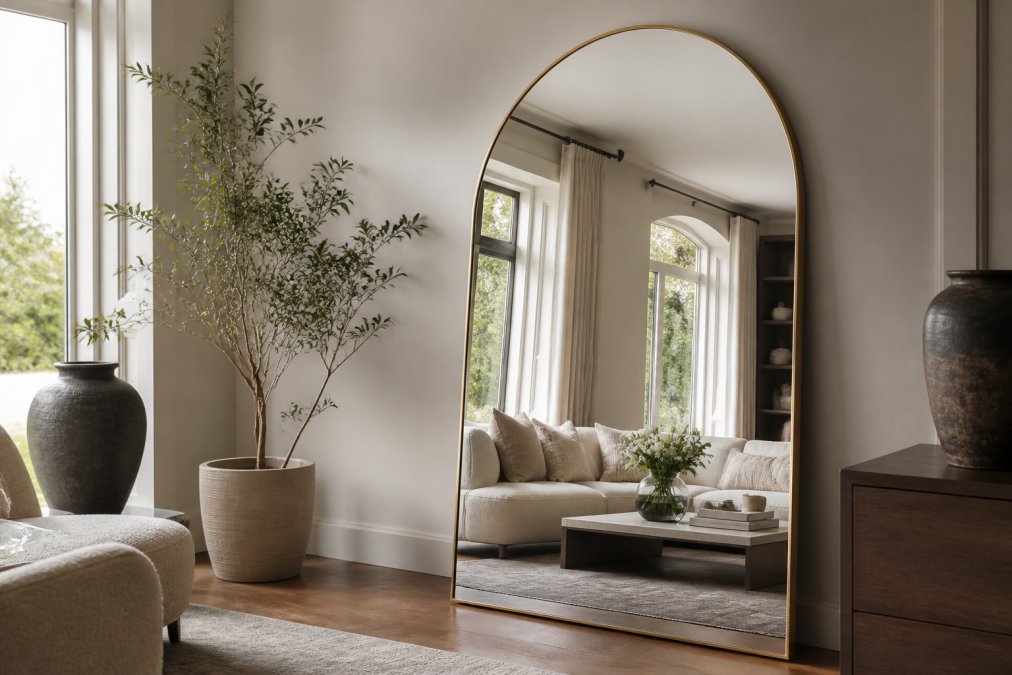
Match the mirror to the furniture below it, not just the wall. As a starting point, a mirror hung above a console or sideboard should be about two-thirds the width of that piece. This keeps the visual weight balanced.
A few practical checks:
Oversized mirrors behave differently depending on the room they are in.
Leaning a large mirror is a popular styling move, and it suits a relaxed, contemporary look. But it comes with two constraints most guides skip.
Shape and frame decide whether a mirror blends in or leads the room. An arched mirror softens a boxy space. A round mirror breaks up straight lines. A rectangular mirror suits a formal, symmetrical layout. Frameless designs disappear into the wall for a minimalist design look.
| Shape | Best For | Style Note |
|---|---|---|
| Arched | Hallways, bedrooms | Softens hard edges |
| Round | Entryways, powder rooms | Breaks up straight lines |
| Rectangular | Living rooms, studies | Formal and structured |
| Frameless | Small, modern spaces | Recedes into the wall |
Framed mirrors add architectural features of their own. A brass or black frame reads as luxury interiors; a timber frame suits warmer, natural schemes. The Classic Round Mirror pairs a black and brass frame with a clear reflective surface, which suits both contemporary and classic rooms. For something more ornate, the Clarendon Round Mirror brings bevelled edges and a burnt gold finish.

Most styling guides stop at the picture hook. This section covers the two things that actually determine whether a large designer mirror stays put and stays bright: correct fixing for the wall type, and a cleaning routine suited to humid and coastal conditions.
Residential walls fall into a few broad categories, and each needs different hardware:
A few practical rules apply regardless of wall type:
A workable routine:
Get the fixing right and the cleaning routine right, and a designer mirror will hold its finish for years rather than months.

The best luxury home decor online stores combine a curated range with clear specifications and honest lead times. That matters when you are buying a piece you cannot see in person. Check the listed dimensions, materials, and finish before you commit.
The 3-5-7 rule is a styling guideline for arranging decorative objects in groups of three, five, or seven items. Odd numbers create visual balance and prevent a space from feeling static. When styling around a designer mirror, group three candles, five books, or seven small objects on a console or shelf nearby. The mirror reflects these groupings, doubling the visual interest without adding physical clutter, which helps maintain a clean modern aesthetic.
Measure the wall space and aim for a mirror that covers roughly two-thirds to three-quarters of the width of the furniture below it. For a console table that is 120cm wide, a mirror around 80cm to 90cm wide works well. Oversized mirrors suit large open-plan areas, while smaller rooms benefit from round or arched shapes that soften hard lines. Always check the product dimensions against your room dimensions before ordering.
Position a mirror on the wall directly opposite a window to bounce natural light deeper into the room. This technique works especially well in narrow hallways and dark living rooms. A large frameless or minimalist mirror maximises reflection without adding visual weight. Avoid placing mirrors opposite each other, which creates an endless reflection loop and can feel disorienting in smaller spaces.
Start by identifying the dominant finish in your room, whether brass, black, or timber, and choose a mirror frame that either matches or deliberately contrasts. A black and brass frame, for example, bridges both warm and cool tones. Place the mirror as a focal point, then style surrounding decor with complementary textures like linen, marble, or ceramic. Avoid competing statement pieces on the same wall to maintain visual balance and proportion.
Placing a designer mirror well takes more than a spare wall. It takes the right shape, the right height, and a fixing that holds. Oscar and Mila can help you get there, with a curated range of mirrors, designer lighting, and decor for interior and exterior spaces. Browse the collection, check the specifications, and choose a piece built to last. Get started with Oscar and Mila and give every room a focal point worth looking at.
Leave a comment