


Last Updated: September 30, 2026
Designer wall sconces are decorative, wall-mounted light fittings chosen for their craftsmanship, materials and designer provenance as much as their function. In a bedroom, they replace the bedside table lamp, free the surface entirely, and put light exactly where you read. Below, we cover seven styling approaches, from installation height to smart control, so you can specify with confidence.
Start with three decisions before you look at a single finish. First, the function: reading light or mood light? Second, the installation: hardwired or plug-in? Third, the scale: how much fixture can the wall and the bed carry? Get those right and the styling almost writes itself.
The Australian standard for domestic electrical installations governs wiring work in this country, which matters the moment you move past a plug-in fitting.
| Decision | Options | Best For |
|---|---|---|
| Function | Task, ambient, or both | Reading vs. atmosphere |
| Installation | Hardwired or plug-in | Owners vs. renters |
| Scale | Compact or statement | Small rooms vs. high ceilings |
| Control | Wall switch, dimmer, smart | Daily convenience |
Mount bedside sconces so the centre of the fixture sits at roughly eye level when seated, generally 90cm to 120cm from the floor. That range keeps the light out of your eyeline while reading and stops glare bouncing off the page.
The exact figure depends on your bed height and mattress depth. A low platform bed pulls the whole composition down; a tall upholstered bed pushes it up. Measure from the top of the mattress rather than the floor if you want the most reliable result, a centre point 45cm to 60cm above the mattress top often lands correctly across a wide range of bed heights.
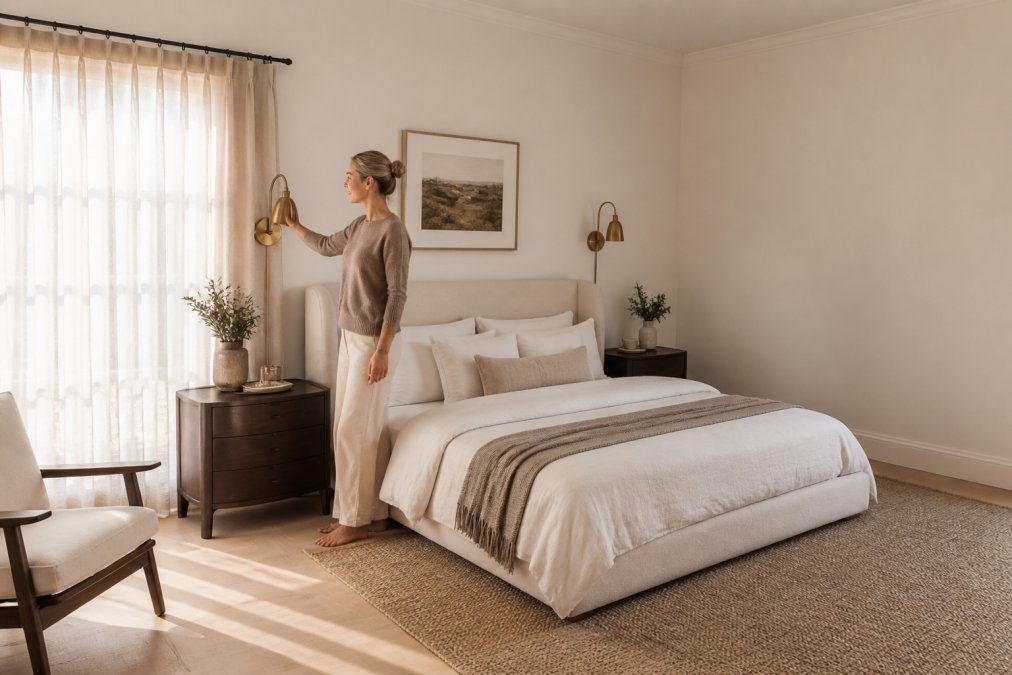
Allow at least 10cm of clearance between the bottom of the shade and the bedside surface. Anything tighter and the fixture crowds whatever you place underneath. If you use a swing-arm or articulated sconce, set the backplate so the arm's pivot sits at mattress height plus 30cm, that gives the head enough travel to reach a book without the arm crossing your face.
Three variables change the number more than any other:
For very low beds or bedrooms where the wall is shared with a wardrobe, a plug-in sconce with a cord cover gives you the same height flexibility without cutting into the wall. The height rule stays the same; only the installation method changes.
Symmetry is the safer choice and asymmetry is the more interesting one. Matching sconces either side of the bed create calm and order, which suits traditional and transitional bedrooms. A single sconce paired with artwork or a floor lamp on the opposite side feels more collected and contemporary.

Asymmetry only works when the two sides share a visual weight. A tall swing arm on one side needs something substantial on the other.
Plug-in sconces need no electrician and no wall cavity, which makes them the practical answer for renters and anyone unwilling to chase walls. A cord cover painted to match the wall hides the cable well enough that most guests never notice it.
Visual Comfort Thomas O'Brien Bryant →
Hardwired fittings give a cleaner result and let you use a proper wall switch.
For a small bedroom, you can drop the ceiling ambient layer entirely and let two dimmable sconces plus a floor lamp carry all three roles. The wall wash from the sconces replaces the ambient contribution, and the floor lamp adds the accent depth that a ceiling fitting would normally provide. This layering pattern can work well in rooms under about 12 square metres.
Reading light and mood light are different jobs, and most bedrooms need both. A reading sconce needs a directional head, enough lumens to light a page without strain, and a shade that shields the bulb from view. A mood sconce needs warmth, diffusion and a low output.
Smart control is an upgrade many people appreciate. A smart dimmer lets you set a bright reading scene and a low evening scene on the same fixture, which solves the reading-versus-mood conflict without buying two lights.
Small bedrooms benefit most from wall-mounted lighting, because it removes the table lamp and returns the bedside surface to you. A low-profile sconce with a shallow extension keeps the room from feeling pinched.
Mount bedside sconces at eye level when seated in bed, generally 90-120cm from the floor. This height prevents glare and keeps the light within easy reach. For reading, position the sconce slightly above your line of sight so the bulb is hidden behind a shade. If you have a taller bedhead or an adjustable swing-arm design, you can fine-tune the height to suit your posture. Always test the placement with a temporary template before drilling into the wall.
Neither approach is wrong, but consistency in finish or material usually looks more considered. If your ceiling light is brass, choose brass sconces to create a cohesive look. For a layered effect, you can contrast shapes, such as a minimalist wall sconce against a decorative chandelier, as long as the colour temperature and style language align. Designer wall sconces from Visual Comfort, for example, come in finishes like antique brass and matte black that pair easily with existing fixtures.
For reading, place the sconce 60-75cm above the mattress and slightly forward of your shoulder so light falls directly onto the page without casting shadows. A swing-arm or adjustable library light, such as the E. F. Chapman Boston Single Arm Library Light, lets you direct the beam precisely. Choose a shade that diffuses light and a bulb with a warm white colour temperature (2700K-3000K) to reduce eye strain. Avoid placing the sconce directly behind your head, as this creates glare.
Yes. Plug-in sconces require no electrical work and simply mount to the wall with screws or adhesive strips, then plug into a nearby outlet. They are ideal for renters because they can be removed without damaging the wall. If you prefer a hardwired look, some sconces can be converted to plug-in with a cord cover kit. Always check your lease agreement before making any holes, and consider freestanding or battery-operated options if drilling is not permitted.
Boutique hotels often use layered lighting and statement sconces to create a sense of luxury. To recreate this, choose sconces with alabaster, brass, or glass shades that diffuse a warm glow. Pair them with dimmable bulbs and position them symmetrically flanking the bed. Add a mix of ambient and task lighting, such as a floor lamp or pendant, to build depth. The Visual Comfort AERIN Clayton Wall Sconce, with its alabaster shade and antique brass finish, delivers that refined, hospitality-style ambiance.
Choosing the right sconces comes down to getting function, scale and finish aligned before you buy, and that is where most projects stall. Oscar and Mila curates designer lighting from Visual Comfort and Ralph Lauren, so you can specify pieces with genuine provenance rather than guesswork. Browse the collection to compare finishes, dimensions and sockets side by side, and get started with Oscar and Mila to light your bedroom properly the first time.
Leave a comment