


Last Updated: October 6, 2026
A dining table is rarely just furniture. It's where families gather for meals, where conversations unfold across years, where children learn to sit still and listen.

The difference lies in construction, materials, and intent. A table built for longevity requires solid hardwood throughout, joinery that tightens rather than loosens over time, and finishes that can be refreshed rather than replaced.
At Oscar and Mila, we understand that discerning homeowners aren't looking for furniture that matches a season's décor. They're looking for pieces that anchor a home, that define how their family lives. The tables we curate, like our Colonnade and Panama ranges, are selected specifically for their ability to serve this role.
Solid wood dining tables are fundamentally different from veneered or composite alternatives. When a table is constructed from solid hardwood, the entire structure, top, base, legs, and internal supports, is made from the same material. This matters enormously for longevity. Veneer, by contrast, is a thin layer of quality wood glued to a cheaper substrate.
Solid hardwood construction means the table can be sanded, refinished, and restored to near-original condition. If a leg cracks, it can be repaired. If the finish dulls, it can be renewed. A veneered table, once the veneer fails, is essentially finished.
The structural integrity of solid wood also matters for stability and safety. A solid hardwood frame doesn't flex or shift the way composite materials do. Joints remain tight. The table feels substantial when you sit at it, and that stability persists for decades if the wood is properly dried and joinery is executed correctly.
Not all hardwoods are equally suited to dining tables. The best wood for dining tables combines hardness, grain stability, and aesthetic appeal. Hardness matters because dining tables endure impact, chairs scraping, dishes set down, children's elbows. Grain stability matters because wood that moves excessively with humidity changes will develop cracks and gaps in joints.
European oak is a classic choice for heirloom quality dining tables. It's exceptionally hard, highly resistant to denting and scratching, and develops a rich patina over time. The grain is pronounced and attractive, and the wood takes stain and finish beautifully. Oak also has excellent dimensional stability, it resists warping and cupping better than many alternatives. The Panama Extension Dining Table, hand-made in salvaged European oak, exemplifies this choice.
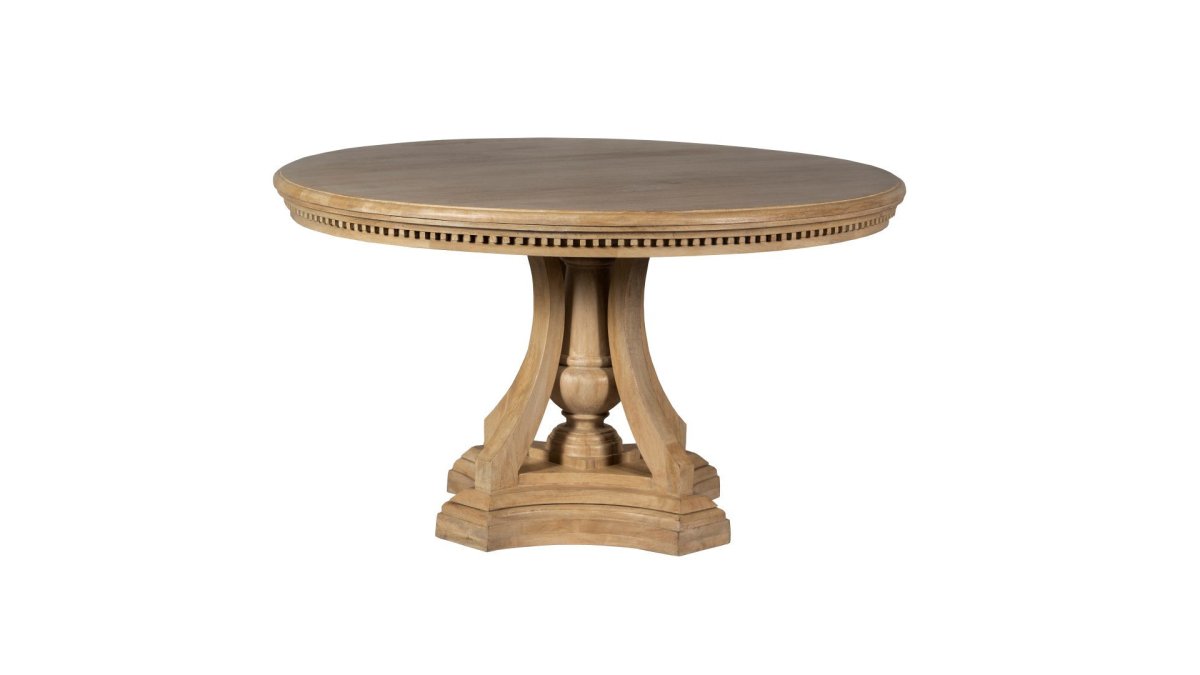
Mango timber offers a different profile. It's a dense, hard tropical hardwood with warm tones and attractive grain variation. Mango is slightly less hard than oak but still highly durable for dining applications. The Colonnade Round Dining Table at 140 centimetres diameter, hand-crafted from solid old mango timbers, demonstrates how this wood can be finished in sophisticated colours like Walnut Grey and Mud Grey. The natural timber variation, knots, distressing, uneven colour, is not a flaw but an enhancement of the wood's character, a visual record of the tree's growth.
Durability in a dining table depends on three factors working together: the hardness of the wood species, the stability of the grain, and the quality of the finish. A soft wood, however beautifully finished, will dent and mark quickly. A stable grain means the wood won't develop gaps as it moves with seasonal humidity changes.
The finishes on quality heirloom tables are usually low-gloss lacquers or hand-rubbed oils. Low-gloss lacquers, like those used on the Colonnade tables, offer excellent protection for everyday use while avoiding the plastic appearance of high-gloss finishes. They can be touched up or refreshed without stripping the entire table. Hand-rubbed oils, by contrast, enhance the wood's natural beauty and age gracefully, though they require more regular maintenance.

Grain selection during manufacture is equally important. Woodworkers building heirloom-quality tables select timber carefully, orienting grain to minimise movement and choosing pieces without major defects. This adds cost but prevents the warping, cupping, and joint failure that plague cheaper tables.
Choosing a dining table that will last generations requires understanding construction, proportions, and your own living patterns. A beautiful table that's poorly proportioned for your space or built with shortcuts will disappoint quickly.
Examine the joints first. Mortise-and-tenon joints, where a projection (tenon) from one piece fits into a cavity (mortise) in another, are the gold standard. These joints are stronger than dowels or pocket-hole screws and tighten with age rather than loosening.
Check the apron (the frame connecting the legs). On quality tables, the apron is solid wood, not veneer, and it's thick enough to support the top without flex. If you can rock the table slightly by pushing down on one corner, the joinery or base design is inadequate.
Inspect the finish. On hand-crafted tables, the finish should be even but not plastic-looking. It should feel warm to the touch, not slick. Examine the edges, are they finished as carefully as the top? Poor finishing on edges and undersides is a sign that quality was compromised.
Ask about wood drying and processing. Quality timber is kiln-dried to specific moisture content before milling, which stabilises the grain and prevents later warping. Reputable makers will explain their process.
Table size must match both your space and your lifestyle. A 240-centimetre table seats six to eight comfortably; a 280-centimetre table accommodates eight to ten. The Colonnade Dining Table comes in both sizes, allowing you to choose based on your family size and entertaining patterns.
Allow at least 90 centimetres of clearance on all sides of the table for chairs and movement. A 240-centimetre table in a 3.5-metre by 4-metre room will feel cramped. The same table in a 4.5-metre by 5-metre room feels balanced.
Consider your entertaining patterns. If you host large gatherings, an extension table like the Panama Extension Dining Table, which extends from 2.8 metres to 3.4 metres, offers flexibility without permanently consuming space.

Table height should be 75 to 78 centimetres, with at least 30 centimetres of clearance between the table top and the seat of a dining chair. All Oscar and Mila's dining tables maintain this standard, with 76-centimetre height and 65-centimetre chair clearance.
Colonnade Round Dining Table 140cm →
The initial price of a heirloom quality dining table is higher than mass-produced alternatives. The Colonnade Round Dining Table starts at $3,450, the rectangular Colonnade at $3,700, and the Panama Extension Dining Table at $6,600. These are significant investments. But total cost of ownership tells a different story.
A budget dining table, typically $400 to $800, will likely require replacement within ten to fifteen years. The finish wears, joints loosen, and repair is impractical. Over fifty years, you might purchase five or six such tables. A heirloom quality table, purchased once for $3,450 to $6,600, can serve the same fifty-year period with periodic refinishing and minor repairs. The cost per year drops dramatically when amortised across decades.
Beyond economics, there's the intangible value of continuity. A table your children grew up around, that hosted their first meals and their graduation dinners, carries meaning that a replacement table never will. When a grandchild eventually sits at that same table, the continuity matters.
A heirloom quality dining table requires maintenance, but the work is straightforward and the results justify the effort. Proper care preserves the finish, prevents damage, and keeps the table looking beautiful.
Use placemats or table runners to protect the finish from heat and moisture. Dishes fresh from the oven, glasses sweating with condensation, and spilled wine are the everyday hazards that degrade finishes. A simple placemat is the easiest defence.
Wipe spills immediately with a soft, slightly damp cloth. Don't let liquid sit on the surface. For stubborn marks, a tiny amount of mild soap in warm water works; dry thoroughly afterward.
Dust regularly with a soft, dry cloth. Dust particles can scratch the finish if rubbed across the surface, so use light pressure and move with the grain.
Avoid placing the table in direct sunlight for extended periods. UV light can fade and damage the finish, and uneven exposure can cause the wood to move unevenly, creating gaps in joints.
Minor scratches and marks are inevitable and, on heirloom tables, part of the character. If a scratch is deep enough to expose raw wood, apply a matching wood stain to prevent moisture from entering the wood, then touch up with lacquer.
If the finish becomes dull or worn in high-traffic areas, the table can be refinished. This is where solid wood construction proves its value. A professional refinishing, sanding the surface, staining if needed, and applying fresh lacquer, restores the table to near-original condition. The cost is typically $800 to $1,500 for a full refinish, far less than replacing the table and a fraction of its original price spread across decades of use.
If a joint loosens or a leg cracks, a skilled woodworker can repair it. These are not catastrophic failures on solid wood tables; they're maintenance. A repair that costs $200 to $400 keeps a $5,000 table functional for another twenty years.
The transition from a table you've purchased to a table your family considers an heirloom happens gradually, through use and care.
It continues through the years of meals shared, conversations held, and small rituals repeated. The scratch your toddler made with a fork. The water ring from your teenager's juice glass that eventually faded. The celebration dinner when someone got engaged.
When refinishing becomes necessary, you choose to restore rather than replace. The table looks renewed, but it's still the same table.
At Oscar and Mila, the tables we select, the Colonnade range in mango timber, the Panama range in salvaged European oak, are chosen because they're built for this journey. Hand-crafted construction, solid timber throughout, finishes designed to be refreshed rather than replaced.
Choosing a heirloom quality dining table means accepting that you're making a decision that extends beyond your own use. You're selecting something your children may inherit, something that could anchor your family's home for generations.
Heirloom quality dining tables combine solid hardwood construction, hand-built craftsmanship, and timeless design that withstands decades of use. They're made from sustainably sourced timber like European oak or old mango timber, finished with durable lacquers, and built using traditional techniques. The natural characteristics, knots, grain variation, and colour variation, are features, not flaws, adding to their authenticity and appeal as pieces meant to pass down through generations.
Yes. Solid wood dining tables offer superior durability and longevity compared to veneer or particleboard alternatives. A well-made table can serve your family for 20, 30, or more years with proper care and occasional refinishing. While the upfront cost is higher, tables like the Panama Extension Dining Table start at $6,600, the total cost of ownership is lower when spread across decades. You avoid replacing inferior furniture repeatedly and gain a piece that appreciates in character and can be refinished to suit evolving styles.
Protect your table with placemats and coasters to prevent heat marks and water rings. Wipe spills immediately with a soft, damp cloth. Use furniture polish sparingly on low-gloss lacquer finishes. Avoid prolonged direct sunlight, which can fade timber. Keep humidity stable in your dining room, extreme fluctuations cause wood movement and cracking. Sand and refinish the surface every 5-10 years depending on use, or repair specific damage professionally. Hand-built tables with natural timber characteristics actually benefit from the patina that develops with age.
Yes. Solid wood tables can be sanded, refinished, and repaired multiple times over their lifetime. Minor scratches and dents can be filled and blended. Deep damage can be sanded out and the finish reapplied. Unlike veneer furniture, solid wood allows for meaningful restoration. Professional refinishing restores the table's appearance and protective finish, making it look new while preserving the underlying timber's character. This repairability is one reason solid wood tables remain valuable investments, they can be restored rather than discarded.
Leave a comment