


Last Updated: September 5, 2026
Mixing vintage and modern decor is less about strict rules and more about cultivating a curated aesthetic that feels personal, layered, and distinctly yours. At Oscar and Mila, we see this transitional style as the hallmark of a sophisticated home, where the goal is to create spaces with depth, history, and character.
The secret to a successful eclectic interior is a deliberate composition guided by a few interior design principles. This guide from Oscar and Mila breaks down the styling tricks that designers use to blend eras seamlessly, so your home feels intentional and cohesive. Below, we’ll cover the 80/20 rule, balancing scale and proportion, and how to use lighting as a bridge between design periods.
The 80/20 rule is the most reliable framework for blending different design periods (architecturaldigest.com). It suggests that you anchor a room with a dominant style, usually modern, and then layer in vintage pieces to add soul and narrative. This prevents the space from feeling like a museum of antiques or a sterile contemporary catalogue.
In practice, your modern sofa, minimalist backdrop, and contemporary lighting form the foundation, while antique furniture, heirloom pieces, and vintage accents are the 20 percent that provide the focal point and tell a story. This ratio makes the room more forgiving; a few striking vintage finds have more impact when not competing with clutter.
Achieving a harmonious mix of vintage and modern furniture comes down to finding a common language between the pieces. The key is to create design contrast through shared characteristics like colour, shape, or material. While these principles are universal, their application shifts dramatically depending on the room. Here is how to apply them in the two most challenging spaces: the small apartment and the modernised kitchen.
In a compact space, the risk of clutter is high, and the margin for error is low. The 80/20 rule becomes even more critical. In a small living area, the '80' should be a neutral, modern base, think a light grey or off-white sofa and a simple, low-profile media unit. The '20' should be one or two high-impact vintage pieces that do not consume floor space.
A vintage kitchen, whether it is original 1950s cabinetry or a recent find of reclaimed timber, presents a different challenge. The goal is not to make it look new, but to make it functional and intentional.

In both a small apartment and a vintage kitchen, negative space is your most powerful tool. Resist the urge to fill every surface. In a small apartment, leave a clear path and a visible area of floor to create a sense of air. In a kitchen, clear the worktops of small appliances and display only one or two functional, beautiful items. This restraint allows the vintage and modern pieces to be seen and appreciated individually, rather than merging into a cluttered mass.
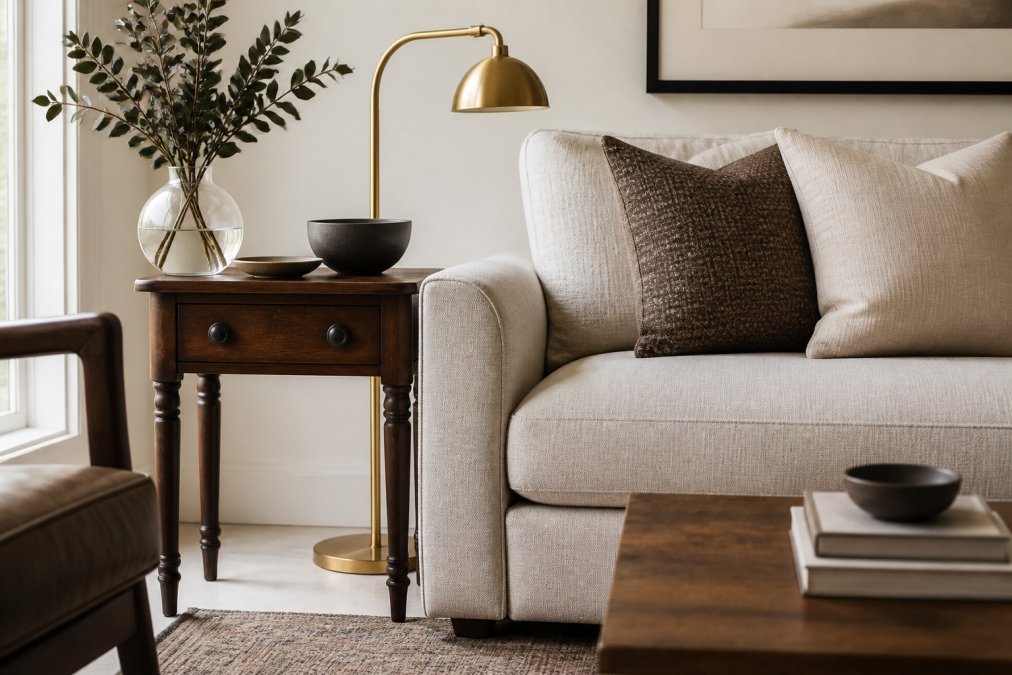
Styling vintage furniture in modern homes succeeds when you prioritise texture layering and material contrast. Introducing vintage pieces with a rich patina, natural wood grain, or aged leather adds a tactile warmth that modern manufacturing often lacks.
The contrast between a rough, reclaimed timber table and sleek, modern upholstery is what creates a space that feels collected over time. Mix organic materials like wool, linen, and stone with the glass and metal of contemporary design to add depth and prevent the room from feeling flat.
Antique lighting is one of the most effective ways to bridge the gap between old and new. A statement chandelier or a pair of sculptural sconces can act as a stunning focal point in a room with otherwise modern furnishings.
Consider how to style antique lighting to create drama. A classic crystal chandelier hung over a minimalist dining table creates an instant sense of occasion and luxury. Alternatively, a pair of vintage wall sconces can flank a modern mirror to add symmetry and a warm glow. This approach allows you to introduce a historical element without committing to an entire room of period furniture.
The line between a curated aesthetic and a cluttered room is defined by restraint. Curating involves selecting pieces that speak to each other, while collecting often results in an accumulation of unrelated items. To avoid a cluttered look, be ruthless about negative space and the quality of each item.
Display fewer, larger pieces rather than many small ones, giving each item room to be appreciated. Before a new vintage purchase, ask yourself if it adds to the story of the room or simply adds noise. A minimalist backdrop with one or two exceptional statement pieces is far more impactful than a maximalist layering of unconnected items.
| Common Mistake | The Fix | Impact |
|---|---|---|
| Matching every wood tone | Mix contrasting woods with a unifying finish | Adds depth and prevents flatness |
| Clustering all small decor | Distribute visual weight across the room | Improves spatial flow and balance |
| Ignoring scale | Pair bulky items with delicate ones | Creates tension and visual interest |
| Overcrowding surfaces | Leave negative space around key pieces | Elevates the curated aesthetic |
Sourcing is where the theory of mixing vintage and modern becomes reality. While high-end antiques and designer showrooms are one path, the most interesting homes are often built on a more resourceful foundation. The key is knowing where to look and how to evaluate what you find.
A common pattern among professional stylists is the 'high-low' approach: invest in a few anchor pieces that will see daily use and need to perform structurally, then save on accent pieces where patina and character are the goal. For example, invest in a high-quality, modern sofa with a solid timber frame, then pair it with a vintage side table found at a local market.
The most significant cost-saving opportunity is learning to see the potential in a piece that needs a little work. A solid timber dresser with a damaged veneer can be sanded back and oiled for under $50 in materials, and a vintage chair with dated fabric can be re-upholstered for a fraction of the cost of a new designer chair (thisoldhouse.com). This practice also aligns with a more sustainable approach to consumption.


Before you hand over any money, conduct a quick structural check. Open all drawers and doors to ensure they slide smoothly, check for solid timber rather than particleboard or MDF, and look for dovetail joints as a sign of quality craftsmanship. For upholstered items, press on the arms and back, there should be minimal give. A piece with a solid frame and good bones is always worth the investment in new upholstery.
Learning how to mix vintage and modern is ultimately about creating a home that reflects your personal narrative, not a rulebook. The goal is to surround yourself with pieces that have meaning, whether they are new investments in craftsmanship or beloved finds with a history.
At Oscar and Mila, we believe a well-styled home is a blend of the stories you inherit and the ones you are writing now. Our collection of designer furniture, lighting, and decor is curated to help you find those perfect bridge pieces, from the classic elegance of the Classic Round Mirror to the functional design of the Visual Comfort Aerin Montreuil Floor Lamp. We invite you to explore our offerings to find the pieces that will illuminate your space and tell your unique story.
The 3-5-7 rule is a styling guideline suggesting that objects arranged in odd numbers, particularly in groups of three, five, or seven, create a more visually appealing and balanced display than even numbers. When mixing vintage and modern decor, use this rule for vignettes on shelves, consoles, or coffee tables. For example, a modern ceramic vase, a stack of vintage books, and a small sculptural object will feel more intentional than just two items.
Balance comes from finding a common thread, usually in colour or material. Choose a cohesive colour palette and stick to it across both eras. Use the 80/20 rule as a starting point: let one style dominate. If your sofa is a sleek modern piece, anchor it with a rustic timber coffee table. Ensure both pieces share a similar visual weight to prevent the room from feeling lopsided.
Curate, don't collect. Select a few statement vintage pieces that have a clear purpose and give them space to breathe. Group them with modern items that contrast in texture or scale to create a deliberate dialogue. Avoid filling every surface; negative space is crucial. A single antique mirror above a modern console creates a stronger focal point than a wall crowded with mismatched art.
Treat antique lighting as jewellery for the room. A classic chandelier or a pair of vintage-inspired sconces can serve as an unexpected focal point against a minimalist backdrop. For a cohesive look, pair an antique brass floor lamp with a clean-lined modern armchair. Ensure the scale of the fixture suits the room, and let the patina of the metal provide the design contrast against sleek, contemporary surfaces.
Mixing different design periods can feel daunting, but it is one of the most rewarding ways to create a home with genuine warmth and character. The challenge is finding high-quality pieces that can anchor this eclectic look. Discover how Oscar and Mila's curated selection of premium furniture and lighting can help you achieve a sophisticated, layered interior, and get started on creating a space that is truly your own.
This article was written using GrandRanker
Leave a comment