


Last Updated: September 18, 2026
Luxury lighting is defined by three things: material quality, construction skill and engineering precision. A brand earns that label when all three hold up under close inspection, not when it simply charges more.
The material list tells you most of what you need to know before you see a fixture in person. Brass, alabaster, hand-blown glass, natural oak and leather-wrapped detailing all age differently to painted metal or acrylic.
Colour temperature (Kelvin) and CRI (Colour Rendering Index) matter more than wattage. A high-CRI light makes timber, stone and fabric look as they do in daylight; a low-CRI light makes everything look slightly grey, however expensive the fixture.
The five brands below represent the strongest designer lighting for contemporary interiors, judged on materials, engineering and in-room performance. Each is available through Oscar and Mila's curated collection.
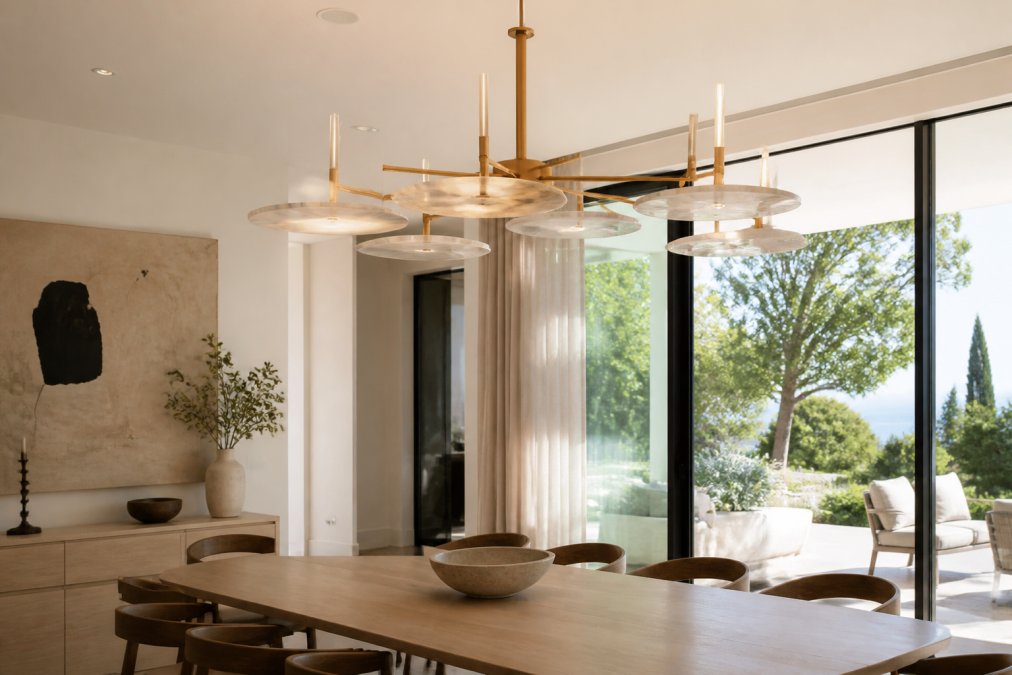
Visual Comfort is the strongest all-round luxury lighting brand for modern homes, pairing established manufacturing with an unmatched roster of designer collaborators. Its catalogue spans coastal, mid-century and contemporary aesthetics without dropping quality between collections.
AERIN is the collection for sculptural form without visual noise. The designs lean on proportion and finish rather than ornament, reading as elegant rather than decorative.
Kelly Wearstler's lighting suits interiors that can carry a statement piece, combining natural alabaster with brass and bronze in unapologetically sculptural forms.
Amber Lewis lighting brings warmth through texture rather than colour. Leather wrapping, curved lines and mixed metal finishes give the pieces a considered, lived-in quality that suits relaxed luxury.
Marie Flanigan's lighting is defined by restraint, using linear forms, natural oak and soft brass to create pieces that feel architectural rather than decorative.
Layering lighting means combining three types of light in one room: ambient fills the space, task supports specific activities, and accent creates depth and highlights architecture or objects. What most guides skip is the specification behind each layer, the numbers that determine whether the finished room feels luxurious or just expensive.
Ambient is your base fill: ceiling pendants, cove lighting, uplights or a large diffused fixture. Aim for 2700K to 3000K in living and dining spaces, and keep CRI at 90 or above so timber, stone and fabric render truthfully. Below CRI 80, even a beautifully finished room reads slightly grey.
A room with three light sources on one switch is still a one-layer room. Every room should have at least three light sources on separate switches or dimmer zones, each dimmable. Dimming lets a space shift from bright task work in the morning to low, warm ambient light in the evening without changing a fixture.
| Room | Ambient | Task | Accent |
|---|---|---|---|
| Living room | Ring or disc pendant, 2700K, CRI 90+ | Floor or table lamp beside seating | Picture light or directional spot on art |
| Dining room | Linear or tiered chandelier, dimmable | , | Wall sconces or a low-level sideboard lamp |
| Kitchen | Recessed or cove fill, 3000K | Island pendants, higher lumens | Under-cabinet strip on the splashback |
| Bedroom | Low-glare ceiling or cove, 2700K | Bedside pendants or reading sconces | Warm accent on a feature wall |
| Entryway | Sculptural pendant as focal point | , | Wall washer on texture or joinery |
These are starting points, not rules. Ceiling height, wall colour and natural light all shift the numbers: a dark-walled room needs more lumens to read as bright, while a room with floor-to-ceiling glazing needs less ambient and more accent to hold its shape after dark.
Visual Comfort AERIN Benit Sculpted →

Stand in the room at night with every light on. Now switch off the central fixture. If the room still reads as warm, considered and usable, your layers are working. If it collapses into darkness or a single harsh pool of light, you have a fixture, not a lighting scheme.
Luxury pendant lighting in Australia should be specified around three things: ceiling height, dimming compatibility and whether the fixture suits the room's proportions. A pendant sized for a two-storey void will overwhelm a standard 2.4-metre ceiling.
| Room | Best Fixture Type | Key Consideration |
|---|---|---|
| Dining room | Linear or tiered chandelier | Width relative to table length |
| Kitchen island | Linear pendant | Even light spread along the bench |
| Entryway | Sculptural pendant or ring chandelier | Ceiling height and drop length |
| Living room | Ring chandelier or disc pendant | Dimming zones and ambient fill |
| Bedroom | Wall sconces and small pendants | Layered, low-glare light |
Designer lighting trends in 2025 favour natural materials, sculptural silhouettes and warm finishes over polished chrome and cool white light. Alabaster, plaster, natural oak, leather and unlacquered brass appear across contemporary collections.
Most luxury lighting guides stop at the silhouette. But two questions decide whether a five-figure fixture is a considered purchase or an expensive mistake: will it integrate with the rest of the home, and will it still be worth owning in ten years?
Smart home integration is a specification question, not an afterthought. Most luxury fixtures work with smart systems provided the dimming method matches. The three protocols you are most likely to encounter are:
Luxury materials age differently, and the care routine matters more than the price tag. A few material-specific notes:
Longevity comes down to material quality, replaceable components and correct installation. Fixtures with standard socket types let you replace globes rather than the whole fitting, a detail that extends working life by years and separates a fixture that can be re-specified into a future home from one that becomes landfill when a proprietary LED module fails.
Visual Comfort leads the field for designer collaborations, with collections from AERIN, Kelly Wearstler, Amber Lewis and Marie Flanigan. Each brings a distinct aesthetic, from sculptural plaster forms to bold alabaster geometry. Look for brands that name their designers, specify materials like brass, alabaster and hand-blown glass, and publish full technical specifications including socket type, dimensions and dimming compatibility.
Luxury lighting is defined by materials, craftsmanship and technical precision. Look for solid brass rather than plated finishes, hand-blown glass or natural stone, and dedicated LED or standard socket configurations that suit your space. Dimmable technology, colour temperature control and high CRI matter too. A fixture with 90+ CRI renders colours accurately, which makes a visible difference in living and dining rooms.
Start with the room's function. A dining room needs a statement chandelier at the right height, typically 75-85cm above the table. Living spaces benefit from layered lighting: ambient, task and accent. Match the fixture's finish to existing hardware, and check dimensions against your ceiling height and room width. For open-plan spaces, a linear chandelier like the Rigby Grande works better than a round pendant because it defines the zone without blocking sightlines.
Yes. Curated boutiques stock international designer brands that are otherwise difficult to source locally. Oscar and Mila, for example, carries Visual Comfort pieces including AERIN, Kelly Wearstler and Amber Lewis collections, with pricing in Australian dollars. Buying through a local boutique also means you get support with specifications, custom height orders and after-sales service.
Designer lighting functions as both a functional necessity and a design asset. A well-chosen chandelier or pendant becomes a focal point that anchors a room's aesthetic, and quality fixtures signal a higher level of finish to buyers. Pieces from established designers like Kelly Wearstler or AERIN hold their appeal because the design language is timeless rather than trend-driven, which supports resale value over time.
Leave a comment