


Last Updated: August 29, 2026
A chandelier that's too large dominates the room; one that's too small disappears visually. The diameter should be roughly one-half to two-thirds the width of your dining table. For a 1.2-metre table, aim for 600-800 millimetres in diameter. This ratio ensures the fixture commands attention without overwhelming the space or blocking sightlines across the table.
For rectangular tables longer than 1.8 metres, consider two smaller chandeliers spaced evenly rather than one large fixture. This distributes light more effectively and maintains better visual proportion.
In rooms with standard 2.7-metre ceilings, a chandelier around 400-600 millimetres tall works well. Taller ceilings (3.3 metres or higher) can accommodate larger, more ornate fixtures. The chandelier's visual weight must match the room's volume.
In intimate dining spaces under 20 square metres, keep fixtures under 800 millimetres in diameter. Larger rooms over 30 square metres can support statement pieces that command real attention. Properly scaled fixtures transform a dining room from functional to genuinely refined.
The distance between the chandelier's lowest point and the table surface is critical. Too low creates a hazard; too high fails to create intimate, layered lighting.
The industry standard is 750-900 millimetres of clearance between the lowest point of the chandelier and the table surface. This keeps the fixture visible and functional without creating safety issues. For tiered fixtures with long crystal strands, err toward the higher end of that range. If your table has tall centerpieces or glassware, add an extra 100-150 millimetres of clearance.
Standard ceiling heights (2.7 metres) call for the bottom of the fixture roughly 1.8-2 metres above the floor. In rooms with lower ceilings (2.4 metres or less), mount the fixture higher to preserve headroom and avoid a cave-like atmosphere. If you have crown moulding or a ceiling medallion, the chandelier should sit roughly 300-400 millimetres below the ceiling for visual balance.
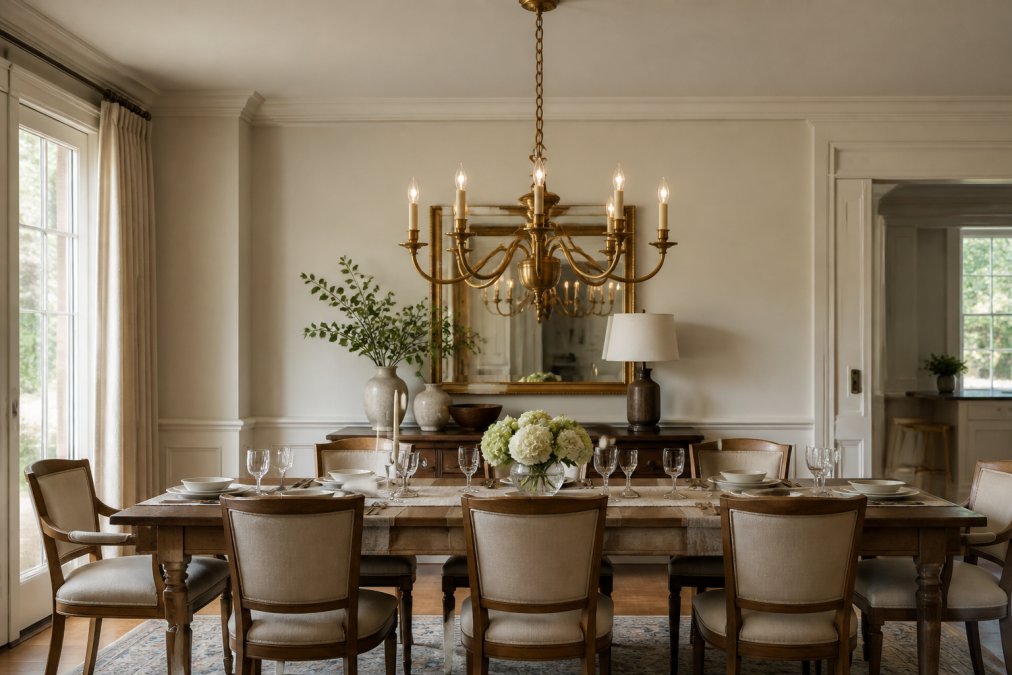
Your chandelier is a statement piece that sets the tone for the entire room. Matching it to your existing décor requires understanding the visual language of different styles and materials.
Traditional dining rooms favour ornate fixtures with multiple arms, crystal elements, or scrolled details in warm finishes like antique brass or bronze. Modern spaces tend toward minimalist fixtures with clean lines and restrained palettes in polished nickel, matte black, or brushed brass. Transitional design borrows refinement from traditional fixtures while stripping away excessive ornamentation, like a brass chandelier with simple linen shades, which is elegant without being fussy.
The key decision: does your chandelier anchor the room's existing style, or establish a new direction? If working within an established aesthetic, match it. If starting fresh, choose a fixture that bridges both worlds.
Brass and antique brass create warmth and work beautifully across traditional, transitional, and contemporary spaces. Brass reflects light warmly and ages gracefully, developing subtle patina over time.
Polished nickel feels crisp and contemporary, reflecting light sharply. It maintains a consistent appearance without patina development, ideal for modern or minimalist rooms.
Wrought iron conveys drama and sophistication, working well in rooms with wood beams or stone accents.
Crystal elements add sparkle and visual interest through light refraction. Crystal works across multiple aesthetics but requires occasional cleaning to maintain its sparkle.
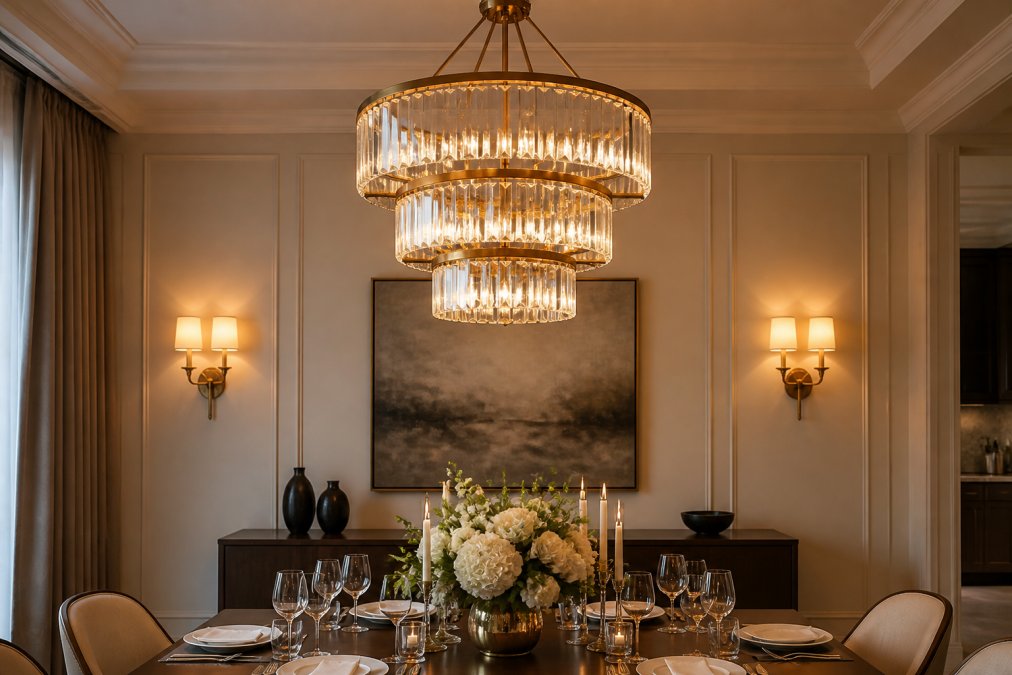
A chandelier alone doesn't create sophisticated lighting. It's one layer in a system that should include task lighting (for the table), ambient lighting (for the room), and accent lighting (for visual interest).
Task lighting illuminates the table itself, bright enough for people to see clearly but not clinical. Warm white tones (around 2700K) work better than cool whites for dining.
Ambient lighting fills the rest of the room through wall sconces, recessed lights, or pendant fixtures. It should be dimmer than task lighting but bright enough that the room doesn't feel dark.
Accent lighting highlights architectural features or artwork, making the space feel intentionally designed.
Install dimmer switches on your chandelier circuit. This transforms the fixture's functionality, bright light for dinner parties, soft light for everyday meals. For colour temperature, stick with 2700K or 3000K in dining rooms. These temperatures complement skin tones, make food look appetising, and create warmth that makes people linger.
A ceiling medallion is a visual anchor that makes a chandelier feel intentionally integrated into the room's architecture. Medallions come in various sizes and styles, plaster suits traditional and transitional aesthetics, while modern rooms often skip medallions entirely or use minimal metal rings.
Installation requires precision. The chandelier must hang perfectly vertical, and the canopy should sit flush against the ceiling. The electrical box supporting the fixture must be rated for the chandelier's weight, in accordance with local electrical safety standards. Standard ceiling boxes often aren't sufficient for heavier fixtures. A professional installer will verify the box can support the load and reinforce if necessary.
You don't need an expensive fixture to create impact. Paint the ceiling a darker shade, deep charcoal, navy, or black makes a chandelier pop visually and draws the eye upward. Add a ceiling medallion even if your fixture is modest; it creates the impression of intentional design at a fraction of the cost of upgrading the chandelier itself.
Layer lighting strategically with wall sconces flanking a mirror or artwork. Use warm-toned bulbs (2700K); colour temperature matters more than fixture price. Clean your chandelier regularly, dust removal transforms how it catches light. Style the table beneath it intentionally with quality linens and thoughtful place settings.
When ready to invest in a genuine statement piece, quality and design matter. Designer chandeliers from established makers like Visual Comfort offer craftsmanship and longevity that mass-produced fixtures don't match.

The Visual Comfort Thomas O'Brien Piaf Large Chandelier combines elegance with restraint. Its six curved arms and linen shades create soft, diffused light. The aged iron and ebonised oak finish works beautifully in transitional spaces and feels timeless.
For more visual drama, the Visual Comfort AERIN Mollino Medium Tiered Chandelier draws inspiration from 1930s French sculpture. Its tiered plaster finish and jewellery-like chain create genuine refinement.

The Visual Comfort Thomas O'Brien Bryant Large Ring Chandelier offers maximum impact. Its circular brass frame and linen shades create a bold focal point that works across traditional and transitional aesthetics.

At Oscar and Mila, we work with discerning clients who understand that a quality chandelier is an investment in how your home feels and functions. The key is choosing something that resonates with your aesthetic and works proportionally in your space. A $2,000 fixture that's wrong for your room looks worse than a $500 fixture that's perfect. The right fixture, even at a premium price, pays dividends in how your space feels every single day.
Styling elegant dining room chandeliers isn't about following rigid rules. It's about understanding proportion, function, and how light shapes atmosphere. Get the sizing and height right, layer your lighting thoughtfully, and choose a fixture that reflects your aesthetic. The result is a dining room that feels intentional, refined, and genuinely luxurious. At Oscar and Mila, we specialise in helping you find the designer chandeliers and lighting solutions that transform your space. Explore our curated collection of premium fixtures and discover how the right piece elevates your home's aesthetic and function.
A: The ideal hanging height for a dining room chandelier is 75-90 centimetres above the surface of your dining table. This distance ensures the fixture creates a focal point without obstructing sightlines across the table. If your ceiling is lower than standard (under 2.4 metres), reduce the distance to 60-75 centimetres. Always verify clearance with your specific ceiling height and table dimensions before installation.
A: Measure your dining table's width in centimetres, then subtract 30 centimetres to determine the ideal chandelier diameter. For example, a 120-centimetre-wide table suits a 90-centimetre chandelier. The fixture should occupy roughly one-third of the table's visual space when viewed from above. Room size also matters: larger rooms with higher ceilings accommodate bigger, more dramatic pieces, whilst smaller spaces benefit from more restrained proportions to maintain spatial balance.
A: The primary rule is proportion: your chandelier should be sized to your table and hung at the correct height to function as a visual anchor without creating hazards. The fixture must clear heads by at least 60 centimetres when seated. Beyond measurements, choose a style that complements your dining room's overall aesthetic, whether modern minimalist, traditional opulent, or transitional. Ensure adequate ambient and task lighting throughout the space for both function and refinement.
A: Crystal chandeliers remain timelessly elegant, particularly in contemporary settings where they create a dramatic effect through crystal refraction and sparkle. Modern designers often pair traditional crystal with clean metal frames or minimalist forms to bridge classic and current aesthetics. The key is selecting a piece that suits your specific interior design vision, whether that's full opulence or understated sophistication. Visual Comfort's curated designer options offer both traditional and transitional styles that work beautifully in 2026 dining rooms.
This article was written using GrandRanker
Leave a comment