


Last Updated: September 20, 2026
A luxury sconce is a wall-mounted light fixture that provides ambient, task, or accent lighting while freeing up floor space, and luxury sconces are the pieces that make a hallway feel considered. Getting the choice right starts with measurements, not inspiration boards.

A common pattern in hallway projects is that the sconce is treated as a finishing touch when it should be one of the first decisions. Here's what to gather before you buy anything:
One warning before you shop: a sconce bought on looks alone is a common regret. Scale and projection matter more than the showroom photo.
Wall sconce placement comes down to two numbers: how high you mount, and how far apart. Most hallways look wrong because one of these is guessed.

Mount sconces at eye level, roughly 150 to 180 cm from the finished floor. This puts the light where faces and artwork sit, not above them.
Spacing depends on the job:
For a deeper look at how the pros set heights around joinery and panelling, the Illuminating Engineering Society design guidance is a useful reference point.
Fixture scale should match the hallway, not fight it. A narrow corridor needs slim, low-projection sconces. A wide gallery hall can carry a taller, more sculptural piece. As a rule of thumb, the fixture's height should sit between one-third and one-half the height of the wall zone it occupies, so a sconce on a 1.2 m wainscot panel should be roughly 40 to 60 cm tall, not 90 cm.
Style should follow the architecture. A period home suits a linen shade and aged brass. A modern interior suits a clean, hardwired fixture with a matte black or nickel finish. The mistake is choosing a style that belongs to a different era of the house, a Bauhaus cylinder in a Federation hallway will always look borrowed.
Material quality is what separates a fixture that ages well from one that dates. Most guides stop at colour; the luxury decision is about how a material behaves over ten or twenty years.
Solid brass versus plated brass. Solid brass is an alloy through and through, so it develops a living patina, a soft, uneven darkening that most designers consider the point, not a flaw. Plated brass is a thin electroplated layer over steel or zinc; it looks identical on day one but can wear through at the edges and around the mounting plate within a few years of cleaning. If a listing doesn't say 'solid' or 'cast', assume plated.
Unlacquered versus lacquered. Unlacquered brass is left raw so it patinates naturally; it needs occasional wiping with a soft cloth and will never look factory-new again. Lacquered brass is sealed with a clear coating that holds the polished look but can yellow or flake in humid coastal conditions. Neither is wrong, they are different commitments.
Hand-blown glass and crystal. Hand-blown glass carries small bubbles and slight thickness variations that scatter light softly; machine-pressed glass is uniform and reads flatter. Lead crystal is denser and throws sharper refractions but is heavier and more brittle, so it suits a fixture with a substantial backplate rather than a slim arm.
Artisanal finishes. Look for named finishes rather than generic colour words. A 'Museum Gild' or 'Hand-Rubbed Bronze' finish implies a multi-stage process, often a base coat, a hand-applied patina, and a wax or lacquer seal, which is why two fixtures in the same nominal colour can look completely different in situ.
The Visual Comfort Kelly Wearstler Lotura 21" Sconce shows this well. Its Museum Gild finish and intersecting geometry are designed to be seen up close, not just from across the room.
For a softer, classic look, the [Visual Comfort Thomas O'Brien(/products/visual-comfort-thomas-obrien-hulton-double-sconce) Bryant Wall Sconce | oscarandmila.com.au] pairs metal with a linen shade. It comes in brass, bronze, antique nickel and polished nickel, so you can match your joinery rather than compromise.
Visual Comfort Kelly Wearstler Lotura →
A luxury sconce is not placed on a wall, it is aligned to it. Before you drill, check three lines:
If the hallway has a repeated architectural rhythm, arches, niches, or a run of doors, space the sconces to that rhythm rather than to a fixed metre measurement. The eye reads alignment faster than it reads distance.
Brightness is measured in lumens, not watts. For hallway wall lights, aim for roughly 400 to 800 lumens per fixture. That's enough to light the space without glare.
Colour temperature is measured on the Kelvin scale. For hallways:
Diffused light matters as much as output. A shade or frosted diffuser spreads the beam and cuts harsh shadows. A bare directional bulb throws a hot spot on the wall and glare down the corridor.
The best luxury hallway lighting ideas treat the corridor as a room, not a passage. The goal is layered light with a focal point.
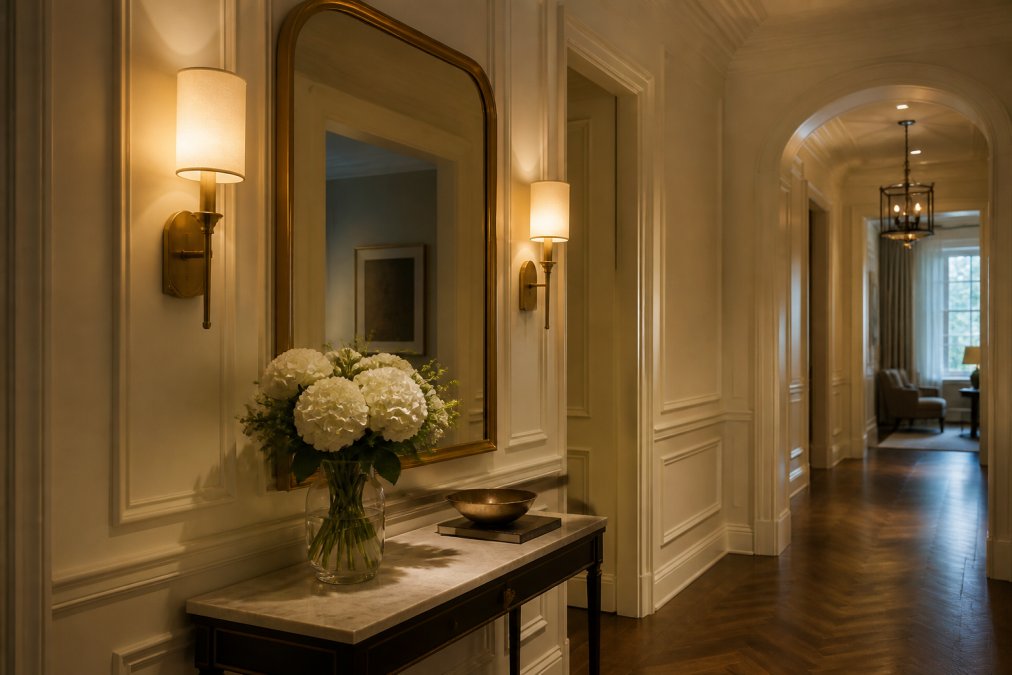
A few approaches that work:
Smart control is what most hallway guides skip. A dimmer switch on a schedule turns a hallway from bright pass-through to evening ambience without touching a dial.
Look for fixtures with LED integration and dimmable drivers. Pair them with a smart switch or app so the corridor brightens for arrivals and softens at night.
How to layer lighting in hallways comes down to three layers working together. Rely on one and the space feels flat.
The biggest mistake is buying on looks and ignoring projection. A sconce with deep extension eats a narrow hallway.
Other traps we see often:
The hardest part of a hallway refresh isn't finding a beautiful sconce. It's matching scale, height, spacing and warmth so the whole run looks intentional.
Mount sconces 152-183 cm above the finished floor, measured to the centre of the fixture. This range suits most ceiling heights and keeps light at eye level for comfortable illumination. For hallways with higher ceilings, you can go up to 198 cm. Always check the fixture's backplate size and ensure it sits flat against the wall. If you have wainscoting or panelling, position the sconce so the backplate is centred on the panel for a balanced look.
For a run down a long corridor, space sconces every 2.4 to 3 metres, measured centre to centre. For pairs in a short hall, use one pair only, centred on the feature. A dimmer switch lets you adjust brightness for different times of day.
A mix of ambient, task and accent lighting works best. Use wall sconces for ambient and accent light, a ceiling fixture or recessed lights for general illumination, and a table lamp on a console for task lighting. For luxury hallways, choose sconces with diffused light to reduce glare and create a soft glow. Colour temperature around 2700-3000K is warm and inviting. Layering these sources adds depth and makes the hallway feel welcoming and well-designed.
Common mistakes include mounting sconces too high or too low, using only one light source, ignoring colour temperature consistency, and choosing fixtures that are too small or too large for the wall. Another mistake is not installing a dimmer switch, which limits flexibility. Also, failing to consider the hallway's architectural style can make fixtures look out of place. Always plan placement and layering before purchasing to avoid these issues.
Leave a comment